
Mitragynine Pseudoindoxyl vs 7OH: Lab Research Guide
- 7OHyea
- 12 hours ago
- 9 min read

Mitragynine pseudoindoxyl (MP) is the more potent mu-opioid agonist of the two: the CFSRE monograph reports a Ki of 1.5 nM for MP versus 78 nM for 7-hydroxymitragynine (7OH), and an ED50 of 0.47 µmol/kg versus 0.66 µmol/kg in rat morphine-discrimination assays. For Canadian laboratories, that gap has immediate consequences: MP’s higher receptor affinity demands lower working concentrations, tighter safety margins, and validated reference standards with batch-specific Certificates of Analysis (COAs) before any assay begins. Critically, human plasma converts a majority of 7OH to MP after 120 minutes, meaning rodent-derived pharmacokinetic data will substantially underestimate human MP exposure. Sourcing from a verified, research-grade Canadian supplier such as 7ohyea, with full COA documentation, is not optional — it is a prerequisite for reproducible results.
Pro Tip: Before designing any receptor-binding or functional assay comparing MP and 7OH, confirm your reference standards carry identity verification by NMR and HRMS, not just declared purity. A mislabeled standard at these potency levels invalidates the entire dataset.
Table of Contents
How do MP and 7OH compare in binding affinity and potency?
The pharmacological distance between these two compounds is wider than most researchers expect when first encountering them as a pair.
Parameter | Mitragynine Pseudoindoxyl (MP) | 7-Hydroxymitragynine (7OH) |
Mu-opioid receptor Ki (nM) | 1.5 | 78 |
ED50 in rat assay (µmol/kg, i.p.) | 0.47 | 0.66 |
GTPγS functional potency vs. 7OH | ~31-fold more potent | Reference |
Chemical class | Spiropseudoindoxyl (semi-synthetic) | Oxidized mitragynine derivative |
Natural occurrence in kratom leaf | Typically absent | Trace amounts |
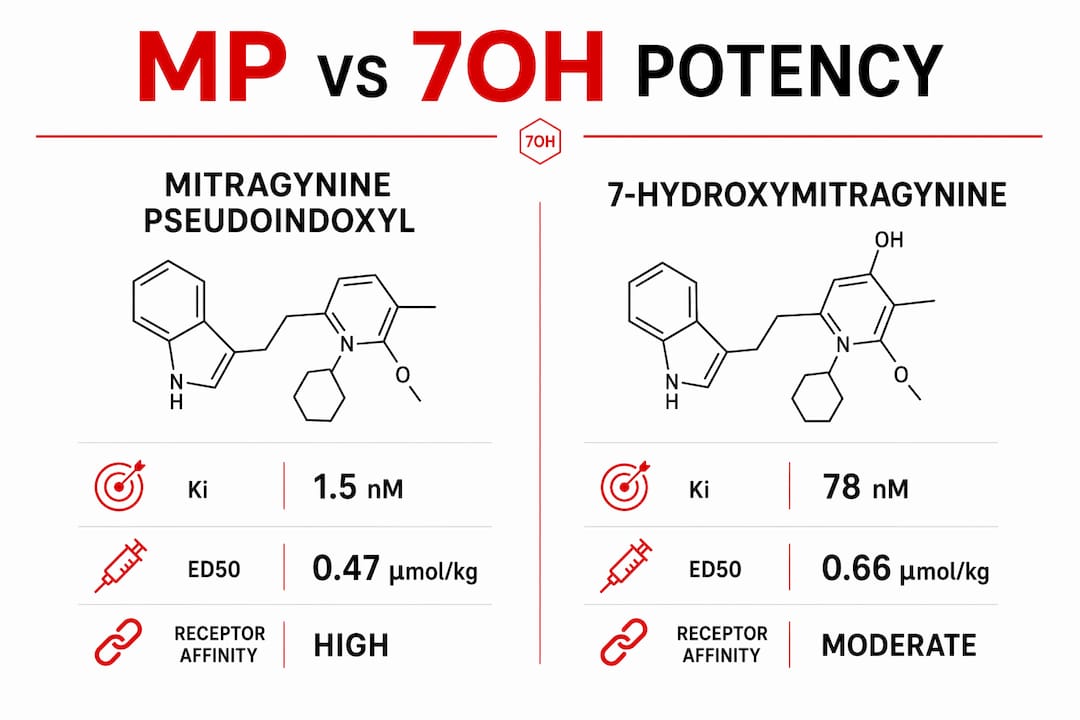
MP’s Ki of 1.5 nM places it above morphine (Ki ~4.0 nM) in receptor affinity, while 7OH sits more than 50-fold lower in affinity at 78 nM. In GTPγS functional assays, MP is approximately 31-fold more potent than 7OH, with an EC50 of 1.7 ± 0.1 nM reported in primary literature. For in vitro assay design, that means your MP working concentrations should start in the low picomolar range, while 7OH assays typically operate in the low nanomolar range. Conflating the two in a shared concentration series will produce misleading receptor-occupancy data.
Pro Tip: When translating ED50 values from rat i.p. studies to in vitro receptor assays, apply a species-correction factor and account for plasma protein binding differences. Use the Ki ratio (MP:7OH ≈ 1:52) as a starting reference for relative concentration spacing in competitive binding experiments.
What are the structural differences between MP and 7OH?
Understanding the molecular identity of each compound before method development prevents misidentification errors that are surprisingly common with these alkaloids.
7-Hydroxymitragynine (7OH): An oxidized derivative of mitragynine, retaining the core indole scaffold with a C-7 hydroxyl group. Occurs naturally in Mitragyna speciosa leaf in trace amounts. Molecular formula: C₂₃H₃₀N₂O₅.
Mitragynine pseudoindoxyl (MP): A spiropseudoindoxyl compound formed by rearrangement of the indole ring system, creating a distinct spiro carbon linkage. Classified by UNODC under molecular formula C₂₃H₃₀N₂O₅ (same formula, different connectivity). Typically absent from raw plant material; produced semi-synthetically or via plasma-mediated conversion from 7OH.
Analytical consequence: The spiro linkage in MP produces distinct MS/MS fragmentation patterns compared to 7OH’s oxidized indole. Without separate validated standards for each compound, co-elution or fragment overlap can cause misidentification in complex matrices.
Structural similarity between MP and 7OH is a known source of analytical error. Both share the same molecular formula, making mass alone insufficient for differentiation. Retention time matching combined with HRMS and MS/MS fragment confirmation against authenticated reference standards is the only reliable identification path. The CFSRE emphasizes that MP is a pharmacologically distinct agonist, not simply a more potent form of 7OH — a distinction with direct toxicology and overdose-risk consequences.
How does human plasma metabolism change the MP vs. 7OH picture?
Species differences in plasma conversion are the single most underappreciated variable when translating preclinical MP/7OH data to human relevance.
Human plasma: 53.8 ± 1.6% of 7OH converts to MP after 120 minutes of incubation under study conditions.
Rodent plasma: Mouse 2.0 ± 0.0%; rat 2.4 ± 0.2% — conversion is minimal.
Non-human primates: Monkey plasma shows 4.3 ± 0.2% conversion, still far below human rates.
Enzyme context: CYP3A4 is implicated in the mitragynine → 7OH step; the plasma enzyme(s) driving 7OH → MP conversion in humans are not yet fully characterized, introducing additional uncertainty for PK modeling.
Translational risk: A rodent study dosed with 7OH will generate negligible MP exposure. The same dose in a human-relevant system produces substantial MP, a compound more than 31-fold more potent in functional assays. Extrapolating rodent PK/PD directly to humans without accounting for this conversion is a significant experimental design error.
Pro Tip: Include a human plasma incubation arm in any translational PK experiment involving 7OH. Run parallel incubations in the relevant animal species plasma to quantify the conversion gap explicitly, and report both the parent compound and MP concentrations as separate analytes.
What analytical methods work best for MP and 7OH?
Validated LC-MS/MS or UPLC-HRMS methods are the appropriate first-line choice for both compounds. GC-MS is not recommended: the thermal instability of the spiropseudoindoxyl core in MP and the sensitivity requirements for trace-level work make GC-MS poorly suited here.
Reference standard and COA checklist:
Identity confirmation by NMR (¹H and ¹³C) and HRMS — declared purity alone is insufficient.
Batch-specific COA with the analytical method used to determine purity.
Stability data under your intended storage conditions (temperature, solvent, light exposure).
Separate, authenticated standards for MP and 7OH — never substitute one for the other.
Method considerations:
Use matrix-matched calibrators when working in plasma; matrix effects on ionization are significant for both analytes.
Design chromatographic separation to resolve MP and 7OH explicitly — their shared molecular formula means MS alone cannot distinguish them without retention time confirmation.
Establish LOD and LOQ for each analyte independently; MP’s higher potency means lower concentrations are analytically relevant.
Validated LC-MS/MS detection workflows for 7OH in Canadian laboratory contexts provide a useful methods baseline that can be extended to include MP.
Pro Tip: When reference standard supply is limited, confirm structural identity using the retention time + HRMS exact mass + at least two MS/MS diagnostic fragment ions. Document all three in your methods section to satisfy peer-review reproducibility standards.
Where can Canadian labs source research-grade 7OH and MP?
A market-monitoring study identified 304 semi-synthetic products sold commercially, with 82.2% marketed as 7OH-only and 14.5% as combination 7OH/MP products. Of those, 73.3% made effect claims and many lacked human safety data. Consumer-market products are not appropriate laboratory reference materials.
Supplier checklist for Canadian laboratories:
Full COA with the analytical method used (not just a purity percentage).
Batch-specific identity data (NMR or HRMS confirmation).
Declared purity at research-grade thresholds (≥95% for reference work; ≥98% preferred for primary standards).
Chain-of-custody documentation and intended-use labeling (research only).
Domestic Canadian sourcing for reliable delivery timelines and reduced import complexity.
7ohyea sources and manufactures research-grade 7OH from British Columbia, offering tablet formats at 15 mg, 30 mg, and 50 mg, as well as 83% pure 7OH powder for labs requiring bulk or formulation-specific work. Each product is accompanied by COA documentation and is labeled for research use only. For institutional procurement, request batch COA, stability data, and intended-use verification before placing an order.
What are the regulatory and safety requirements for Canadian labs?
Kratom alkaloids, including 7OH and MP, are not nationally scheduled under Canada’s Controlled Drugs and Substances Act as of current guidance, but that status is actively monitored. The UNODC issued an alert in 2025 highlighting the emergence of potent 7OH and MP products and calling for enhanced forensic testing and inclusion in early warning systems. Canadian labs should treat regulatory status as subject to rapid change and confirm current requirements with institutional counsel before ordering.
Laboratory safety checklist:
Appropriate PPE (gloves, lab coat, eye protection) for handling potent opioid agonists.
Designated chemical storage with controlled access and temperature/desiccation controls.
Documented SOPs explicitly declaring materials are for research use only.
Staff training on the pharmacological potency of these compounds relative to morphine.
Disposal per institutional hazardous-waste procedures with documented chain-of-custody.
Routine monitoring of Health Canada, UNODC, and FDA advisories for regulatory updates.
This article provides general scientific information only and does not constitute legal or regulatory advice. Confirm current Canadian requirements with your institutional safety office and legal counsel.
How should labs receive, store, and verify these materials?
Receiving and initial QC:
Inspect packaging integrity on arrival; reject any lot with compromised seals or temperature excursions.
Verify COA against the received batch number before logging into inventory.
Run an identity check (retention time + HRMS) on a small aliquot before committing the lot to experiments.
Log batch into a restricted-access inventory system with date received, storage location, and responsible researcher.
Storage:
Store at –20°C in amber vials with desiccant; protect from light and moisture.
Prepare single-use aliquots to avoid repeated freeze-thaw cycles, which degrade both MP and 7OH over time.
Re-verify purity by HRMS at regular intervals (every 6 months minimum) and after any temperature excursion.
Pro Tip: When running spiking experiments, document the exact aliquot used, its storage history, and the date of last identity verification. Reviewers increasingly require this provenance detail in methods sections for alkaloid studies.
What experimental pitfalls should researchers anticipate?
Species-dependent metabolism: Rodent plasma converts less than 3% of 7OH to MP; human plasma converts more than 50%. Never extrapolate rodent exposure data to human exposure without a plasma-conversion correction.
Variable commercial product composition: Semi-synthetic products frequently contain mixtures of MP, 7OH, mitragynine, and other alkaloids. Consumer-market lots are unsuitable as experimental controls.
Co-elution and matrix effects: MP and 7OH share the same molecular formula; without chromatographic separation and MS/MS confirmation, misidentification is a real risk in plasma matrices.
Mislabeled standards: Confirm identity with orthogonal methods (NMR + HRMS) on every new lot, regardless of supplier claims.
Inter-individual variability in conversion: Human plasma conversion rates likely vary across individuals; plan experiments to report ranges and include conversion controls rather than single-point estimates.
Lack of human safety data: No clinical safety profile exists for MP at research doses in humans; handle with the same precautions applied to potent scheduled opioids.
Key Takeaways
MP is the more potent mu-opioid agonist, with a Ki of 1.5 nM versus 78 nM for 7OH, and human plasma converts more than half of administered 7OH to MP — making species selection and validated reference standards the two most consequential decisions in any comparative study.
Point | Details |
MP is more potent than 7OH | Ki 1.5 nM vs. 78 nM; ED50 0.47 vs. 0.66 µmol/kg; ~31-fold more potent in GTPγS assays. |
Human plasma conversion is critical | 53.8% of 7OH converts to MP in human plasma after 120 min; rodent conversion is under 3%. |
Validated COAs are non-negotiable | Request NMR/HRMS identity confirmation and batch-specific COAs before any assay begins. |
Regulatory status is evolving | Kratom alkaloids are unscheduled in Canada now, but UNODC and FDA alerts signal active surveillance. |
7ohyea for Canadian sourcing | 7ohyea supplies research-grade 7OH from British Columbia with COA documentation and research-only labeling. |
The gap between potency data and experimental reality
The pharmacology data on MP is unambiguous: it outperforms 7OH at the receptor level by a wide margin. What the literature does not always make clear is how dramatically that gap widens once you factor in human plasma conversion. A lab that doses a human-relevant system with 7OH and measures only the parent compound is, in effect, missing the primary pharmacologically active species. That is not a minor methodological footnote — it changes the interpretation of potency, safety margin, and dose-response relationships in ways that can invalidate a study’s conclusions.
The other underappreciated issue is the commercial supply chain. Most products marketed as 7OH or MP in the consumer space are semi-synthetic mixtures with inconsistent composition. Using those as research inputs introduces uncontrolled variables that no statistical method can fully correct for. The discipline of sourcing verified, batch-documented reference materials from a supplier with domestic Canadian logistics is what separates publishable data from noise.
7ohyea supports your lab with research-grade 7OH and documented sourcing
Canadian labs working with 7OH and related alkaloids need more than a product — they need documentation they can cite, purity they can verify, and a supplier that understands research-only use. 7ohyea provides exactly that: research-grade 7OH tablets at 15 mg, 30 mg, and 50 mg, plus high-purity powder formats, all sourced and manufactured in British Columbia with batch-specific COAs and research-only labeling.
For institutional procurement, contact 7ohyea directly to request batch COA documentation, stability data, and technical specifications before placing your order. Qualified research teams can also explore the full product catalog at 7ohyea.ca for current SKU availability and bulk purchasing options.
Useful sources for further reference
CFSRE Monograph — Mitragynine Pseudoindoxyl: Primary source for Ki (1.5 nM) and ED50 (0.47 µmol/kg) values; use for head-to-head pharmacology data and MP identification context.
PMC — Metabolism of a Kratom Alkaloid Metabolite in Human Plasma: Source for human plasma conversion rates (53.8%) and species comparison data; use for metabolism and translational PK sections.
UNODC Announcement — August 2025: Surveillance alert on 7OH/MP emergence; use for regulatory context and early-warning system updates.
UNODC Substance Entry — Mitragynine Pseudoindoxyl: Chemical identifiers (CAS 2035457-43-1, molecular formula) for analytical reference.
ScienceDirect — De Facto Opioids Market Characterization: Market-monitoring data on semi-synthetic product composition and labeling variability; use for sourcing cautions and limitations sections.
FASEB Journal — Crowley et al., 2021: Comparative MOR pharmacology across mitragynine, 7OH, and MP including GTPγS, drug-discrimination, and antinociception data.
Recommended
Comments