
7OH Powder vs Tablets: A Researcher's Protocol Guide
- 7OHyea
- 13 hours ago
- 6 min read

For laboratory and analytical work with 7-hydroxymitragynine (7OH), the choice between powder and tablet form is not a matter of preference — it is a protocol decision. Powder suits dose-response titration and exploratory study designs where flexibility matters most, while tablets deliver standardized, reproducible doses suited to routine or high-volume analytical workflows.
Before selecting a form, consider these key attributes side by side:
Dose flexibility: Powder allows continuous titration; tablets are fixed at the manufactured strength.
Handling complexity: Powder requires micro-analytical weighing and moisture control; tablets are ready to use as received.
Batch consistency: Tablets offer tighter lot-to-lot uniformity; powder purity can vary by grade and supplier.
Purity profile: High-grade powders can reach 93% alkaloid purity; tablets introduce excipients that must be accounted for in sensitive assays.
Stability: Tablets resist moisture and oxidation better, giving them a longer effective shelf life under standard lab storage.
The right form depends on where your study sits in its lifecycle and what your analytical method demands.
Table of Contents
How powder and tablet formulations differ for laboratory research
What 7ohyea offers in research-grade purity, dosing, and compliance
How to select the right 7OH form for your specific research protocol
Choosing between 7OH powder and tablets for precise analytical research
7ohyea supplies research-grade 7OH in both forms, ready for your lab
How powder and tablet formulations differ for laboratory research
The scientific distinction between 7OH powder vs tablets runs deeper than physical form. Each formulation carries specific implications for study design, sample preparation, and data reproducibility.
Dose titration and flexibility
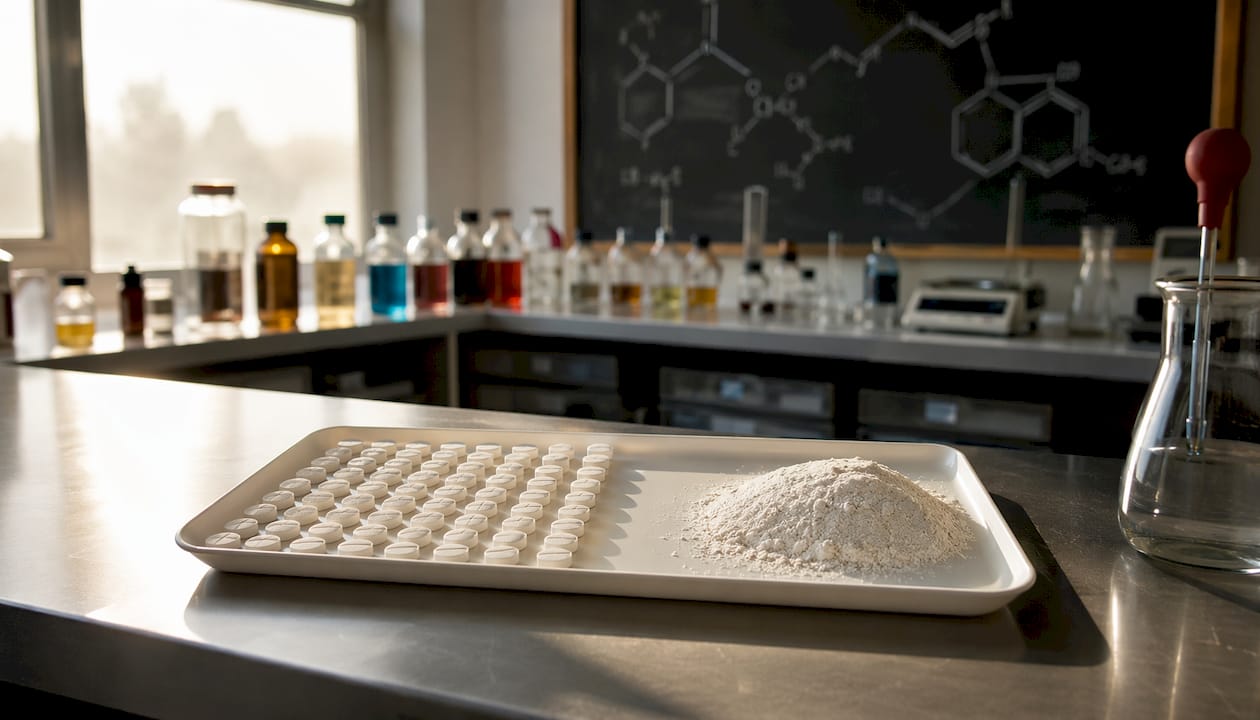
Powder provides the highest dose flexibility of any 7OH format, allowing researchers to prepare custom concentrations for dose-response curves or pharmacokinetic modeling. That flexibility comes with a requirement: precise weighing with a micro-analytical balance is mandatory, since 7-hydroxymitragynine’s high potency means even small measurement errors can meaningfully shift experimental outcomes.
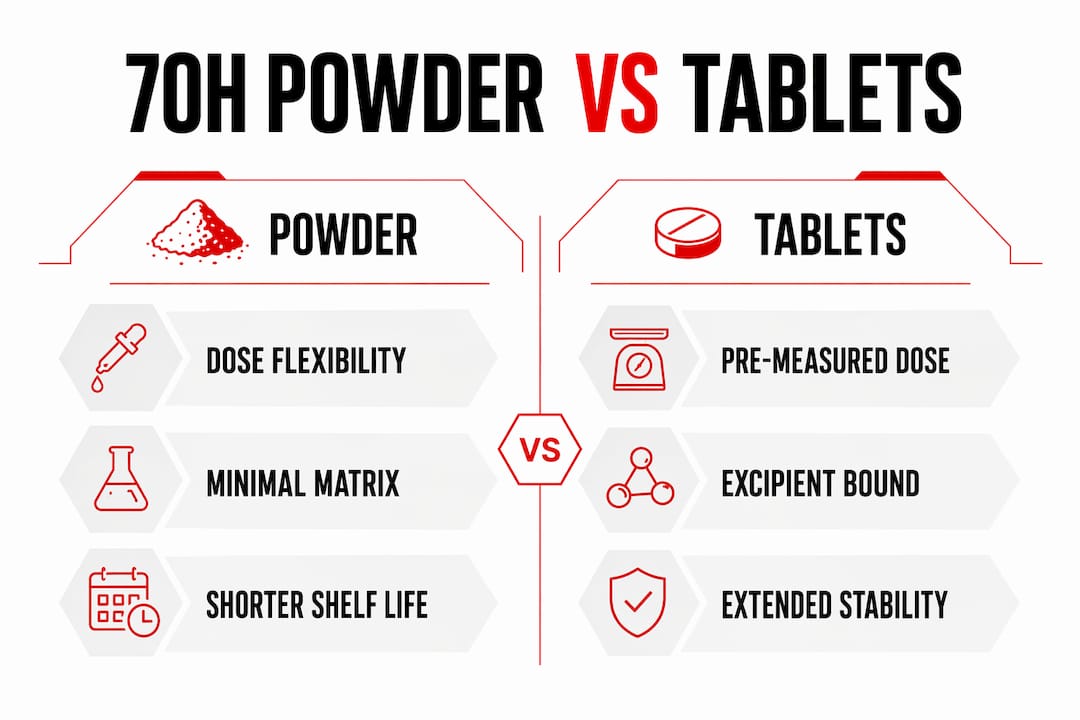
Tablets eliminate that variable. Each unit contains a compressed, pre-measured alkaloid mass, which makes them the preferred form when protocol reproducibility across multiple operators or sites is the priority.
Batch consistency and excipient interference
Tablet manufacturing binds the active alkaloid with excipients — commonly microcrystalline cellulose and magnesium stearate — that provide structural integrity and compressibility. These excipients can interfere with sensitive analytical assays, particularly LC-MS/MS or fluorescence-based methods where matrix effects matter. Researchers running high-sensitivity assays should factor excipient composition into their method validation.
High-purity powder, by contrast, delivers the alkaloid with minimal matrix, making it better suited to reference standard preparation and assay calibration work.
Stability and shelf life
Tablets offer greater resistance to moisture and oxidation than loose powder, which translates to a longer usable shelf life under standard laboratory storage conditions. Powder is hygroscopic and will absorb ambient moisture if improperly sealed, leading to clumping and potential degradation of the alkaloid matrix.
Attribute | 7OH Powder | 7OH Tablets |
Suitability for study design | Dose-response, pilot, and calibration studies | Standardized, routine, and multi-site protocols |
Dose flexibility | Continuous titration possible | Fixed at manufactured strength |
Batch consistency | Dependent on supplier grade | Tighter lot-to-lot control |
Purity levels available | Up to 93% alkaloid content | Active alkaloid plus excipients |
Dosage options | Researcher-defined | 15mg, 30mg, 50mg |
Legal sourcing compliance | Requires verified supplier | Requires verified supplier |
What 7ohyea offers in research-grade purity, dosing, and compliance
7ohyea sources and manufactures its 7-hydroxymitragynine products in British Columbia, Canada, with quality assurance protocols designed specifically for laboratory and analytical procurement — not consumer use.
On the powder side, 7ohyea supplies 93% pure 7OH powder and an 83% purity grade, giving research teams the option to select alkaloid concentration based on their assay sensitivity requirements. Both grades are third-party lab tested, with Certificates of Analysis available to support method validation and regulatory documentation.
Key product attributes for research procurement:
Third-party laboratory testing with documented purity verification
Powder grades at 93% and 83% alkaloid content for tiered research applications
Tablet strengths at 15mg, 30mg, and 50mg to match protocol dose requirements
Full-spectrum tablet combining 15mg 7OH with 40mg Mitragynine for studies requiring a defined multi-alkaloid matrix
Domestic Canadian sourcing with fast cross-border delivery to U.S. research facilities
Compliance with applicable legal guidelines governing research-grade alkaloid procurement in the United States
Purity note: 7ohyea’s 93% pure powder represents one of the higher alkaloid concentrations available in the research-grade 7OH market, supporting applications where matrix interference must be minimized.
The full-spectrum tablet combining 7OH and Mitragynine is a specialized option for researchers studying alkaloid interaction profiles or designing comparative studies between isolated and combined alkaloid matrices. That product category is not widely available from domestic suppliers, which makes it a meaningful differentiator for labs working on Mitragyna speciosa alkaloid characterization.
How to select the right 7OH form for your specific research protocol
Choosing between powder and tablet form starts with a clear assessment of your study’s analytical demands, not a general preference for one format.
Selection criteria to evaluate before ordering:
Does your protocol require variable dosing across experimental arms, or is a fixed dose sufficient?
Will the alkaloid be used in a matrix-sensitive assay where excipients could introduce interference?
How many operators will handle the material, and what is their weighing precision capability?
Is this a pilot or exploratory study, or a scaled, routine analytical workflow?
What are your storage conditions, and can you maintain desiccated, airtight containment for powder?
Scaling research typically begins with powder during pilot phases, where dose optimization and method development require flexibility, then transitions to tablets once the protocol is locked and reproducibility across runs becomes the primary concern. That progression is not universal — some assay types, particularly reference standard preparation, may use powder throughout — but it reflects the most common laboratory workflow pattern.
For storage, powder requires airtight containers with desiccant packs and should be kept away from humidity and temperature fluctuation. Tablets can tolerate standard ambient lab storage conditions with considerably less active management.
Pro Tip: When working with 7OH powder, weigh each sample immediately before use rather than pre-weighing batches. Hygroscopic uptake between preparation and use can shift the effective alkaloid mass, particularly in humid laboratory environments.
Choosing between 7OH powder and tablets for precise analytical research
The core distinction holds across study types: powder gives you control, tablets give you consistency. Neither form is categorically superior — the right choice is the one that matches your protocol’s demands.
Summary of best-use scenarios:
Use powder when your study requires dose titration, custom concentration preparation, or reference standard work where excipient-free alkaloid is necessary.
Use tablets when your protocol demands standardized dosing across multiple runs or operators, or when handling simplicity and storage stability are operational priorities.
Consider the full-spectrum tablet when your research design involves combined alkaloid matrices rather than isolated 7-hydroxymitragynine.
Prioritize supplier quality above form selection — raw alkaloid purity and batch documentation determine data reproducibility more than the physical format does.
Verify legal compliance at the point of procurement; sourcing from a supplier with documented regulatory adherence protects your lab’s procurement records and institutional review requirements.
7ohyea’s quality assurance framework, domestic sourcing, and tiered purity options make it a reliable procurement source for U.S. research teams working with 7-hydroxymitragynine in either form.
7ohyea supplies research-grade 7OH in both forms, ready for your lab
Research teams that need verified-purity 7-hydroxymitragynine without the sourcing uncertainty that comes with unvetted suppliers will find 7ohyea’s product line built for exactly that requirement. Every batch ships with third-party lab documentation, and the range covers both forms across multiple concentrations and dose strengths.
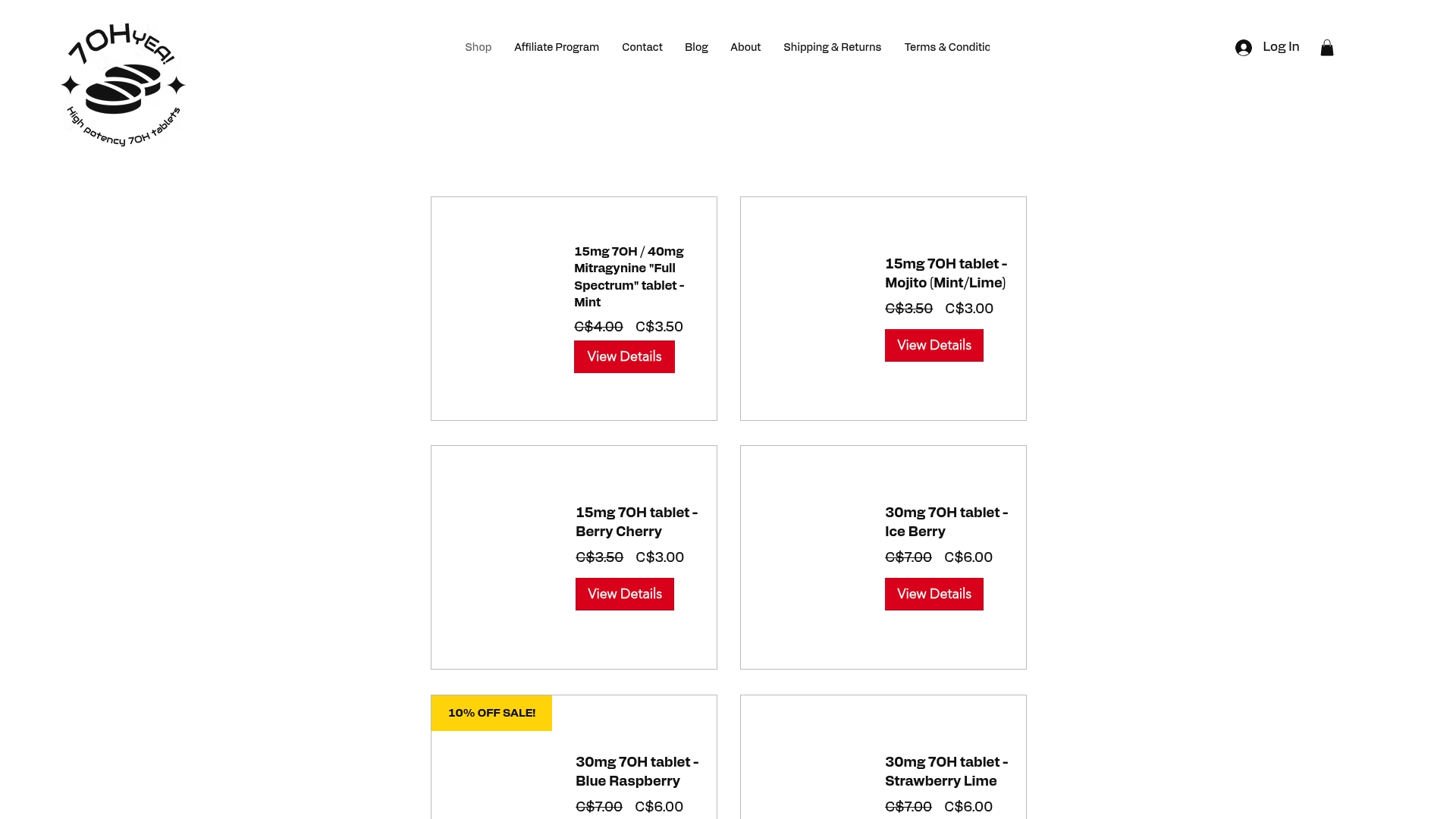
For powder applications, the 93% pure 7OH powder is the highest-purity option in the catalog, suited to assay calibration and reference standard preparation. For standardized tablet protocols, the 30mg tablet and the 50mg tablet cover the mid-to-high dose range most commonly used in analytical research designs. The full-spectrum option adds a defined Mitragynine co-matrix for multi-alkaloid studies. Place your order directly through 7ohyea’s research catalog and receive documented, lab-tested material with fast delivery to U.S. facilities.
Key Takeaways
Powder and tablets serve distinct research functions: powder enables flexible dose titration while tablets deliver standardized, reproducible alkaloid doses suited to routine analytical protocols.
Point | Details |
Form determines protocol fit | Powder suits pilot and titration studies; tablets suit standardized, multi-run workflows. |
Excipients affect assay sensitivity | Tablet binders like microcrystalline cellulose can interfere with sensitive analytical methods. |
Powder requires active storage management | 7OH powder is hygroscopic and needs desiccated, airtight containment to maintain sample integrity. |
Purity grades matter more than form | 7ohyea’s 93% and 83% powder grades give researchers documented alkaloid concentration for method validation. |
7ohyea covers both forms | Tablets at 15mg, 30mg, and 50mg, plus high-purity powders, are available with third-party lab documentation for U.S. research procurement. |
Recommended
Comments