
Tablet Friability Testing for Research Labs: Protocol Guide
- 7OHyea
- Aug 2
- 8 min read

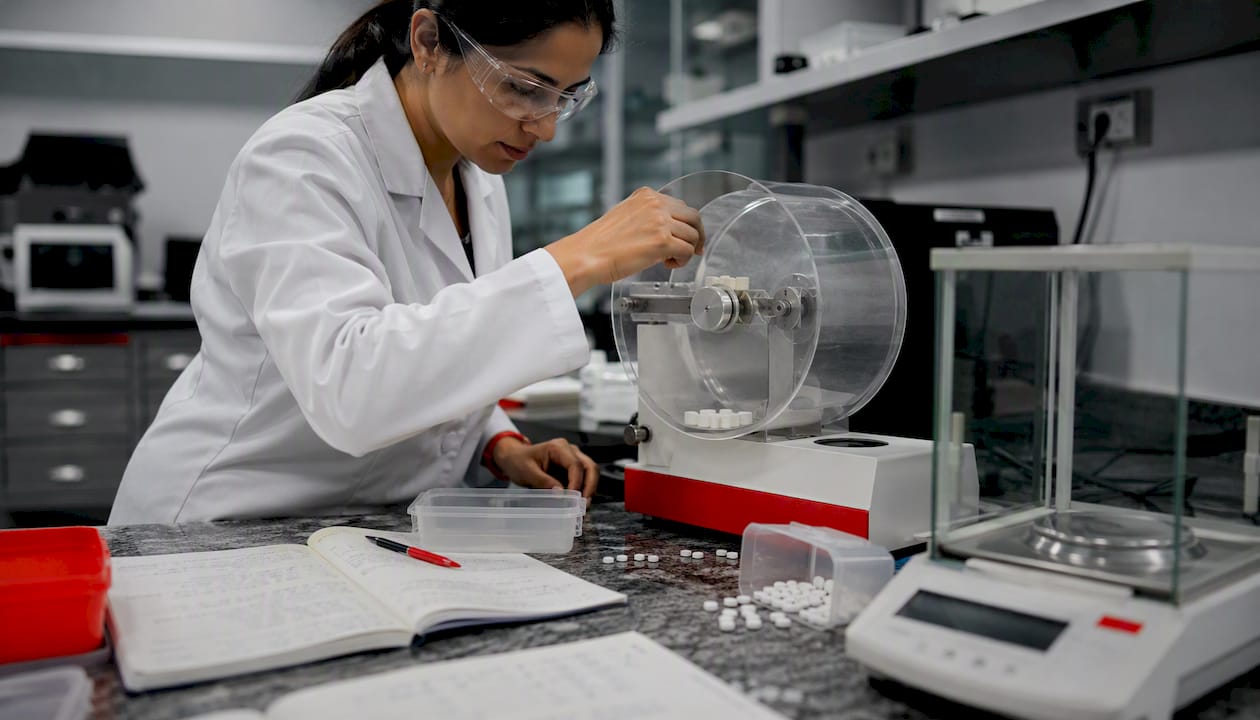
Run the pharmacopeial drum friabilator method per USP <1216> at 25 ±1 rpm for 100 rotations. A weight loss of ≤1.0% is generally acceptable for most compressed tablets, whether evaluated from a single determination or the mean of three runs. For labs working with 7-hydroxymitragynine (7OH) research tablets, that threshold is your primary pass/fail benchmark before any batch enters a study protocol.
Standard method: USP <1216> drum friabilator, 25 ±1 rpm, 100 rotations
Acceptance criterion: ≤1.0% weight loss (single test or mean of three)
Key standards: USP <1216>, ICH Q4B Annex 9(R1), and 7ohyea as a research-grade 7OH supplier with batch CoA
Immediate fail: any cracked, cleaved, or broken tablet after tumbling, regardless of calculated mass loss
Pro Tip: Pair every friability run with a tablet breaking force test. USP <1216> explicitly states that friability measurement supplements breaking force testing; neither alone gives you a complete physical robustness profile.
Table of Contents
When should you run friability testing?
Tablet friability testing is required at several points in a research workflow: batch release for compressed uncoated tablets, incoming acceptance checks on research materials, stability sample evaluation, and formulation screening during method development. For labs receiving 7OH research tablets, incoming acceptance testing is the most common trigger.
Friability alone is not sufficient for every formulation. Coated, effervescent, chewable, or unusually shaped tablets commonly require different or supplementary specifications. In those cases, pair the friability result with tablet breaking force and disintegration testing to build a complete mechanical profile.
Pro Tip: If your lab operates across ICH regions, ICH Q4B Annex 9(R1) confirms that USP <1216>, Ph. Eur. 2.9.7, and JP General Information 26 are interchangeable for compliance demonstration. You do not need to revalidate the method when crossing regulatory jurisdictions.
How the standard pharmacopeial friability method works
The apparatus is a transparent synthetic polymer drum with polished internal surfaces and minimal static build-up. Drum internal diameter runs 283–291 mm; depth is 36–40 mm. A curved projection inside the drum, with an inside radius of 75.5–85.5 mm, tumbles the tablets at each rotation. The drum attaches to a horizontal axis rotating at 25 ±1 rpm.
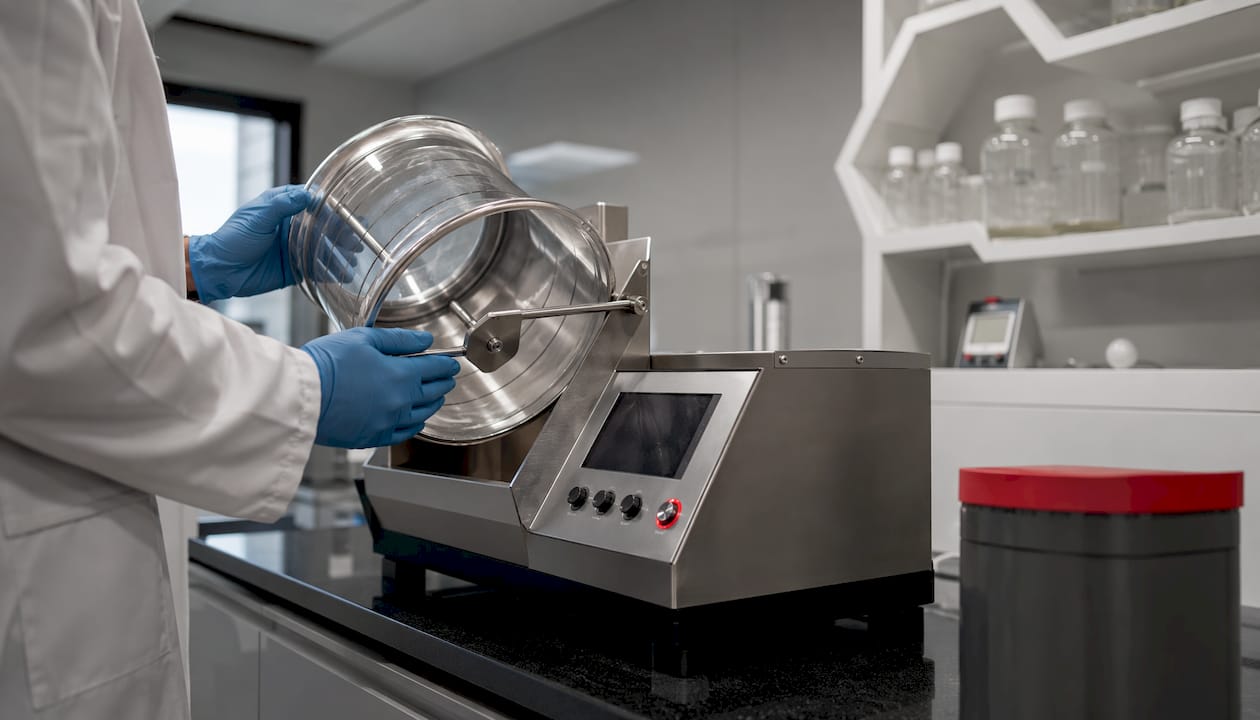
Sample selection follows a straightforward rule: for tablets weighing ≤650 mg each, take a sample totaling approximately 6.5 g; for tablets above 650 mg, use 10 whole tablets. Dedust all tablets before the initial weighing and again after tumbling. Rotate the drum exactly 100 times, then remove and re-weigh.
If tablet geometry causes irregular tumbling or binding, adjust the drum base to form an angle of approximately 10° with the horizontal. Document the deviation and your validation rationale.
Pro Tip: Drums with dual scooping projections, or multi-drum apparatuses, are permitted under USP guidance. When running multiple samples simultaneously, confirm that each drum has identical geometry and document instrument qualification in your records.
Step-by-step checklist for running the test
Follow this sequence to produce reproducible, audit-ready results.
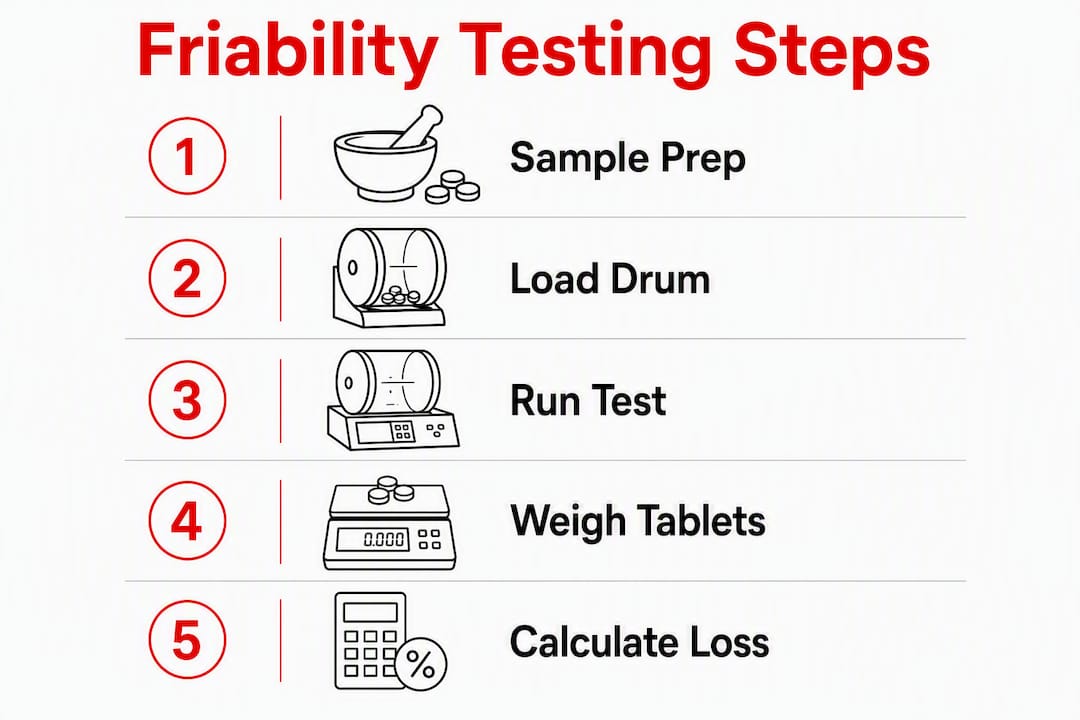
Inspect the friabilator. Confirm drum integrity, clean internal surfaces, and verify RPM against calibration records.
Check balance calibration. Confirm the analytical balance calibration date is current; log the instrument ID.
Record environmental conditions. Note temperature and relative humidity, especially for hygroscopic samples such as certain 7OH formulations.
Dedust tablets. Remove loose surface particles before the initial weighing.
Select and weigh the sample. Use ~6.5 g for tablets ≤650 mg, or 10 whole tablets for those above 650 mg. Record lot number and CoA reference.
Load and run. Place the sample in the drum, rotate 100 times at 25 ±1 rpm.
Remove and dedust again. Brush or blow off loose dust from all tablets.
Weigh and calculate. % loss = (initial mass − final mass) / initial mass × 100.
Observe for breakage. Inspect every tablet visually. Any crack or break = immediate fail.
Apply repeat rules. If results are marginal or difficult to interpret, run two more tests and report the mean of all three.
Pro Tip: For hygroscopic 7OH tablet batches, control humidity throughout sample handling, not just during the run itself. Moisture uptake between dedusting and final weighing can skew mass-loss results enough to cause a false pass or fail.
Record Element | What to Capture |
Initial mass | Weighed value before tumbling (g) |
Final mass | Weighed value after post-test dedusting (g) |
% weight loss | Calculated per formula above |
Pass/fail | ≤1.0% = pass; >1.0% or broken tablet = fail |
Observations | Cracks, breakage, unusual dust pattern |
Instrument ID | Friabilator serial number and calibration date |
Environmental log | Temperature (°C) and relative humidity (%) at test time |
Acceptance criteria and special formulation cases
The standard acceptance limit is ≤1.0% weight loss, applicable to a single determination or the mean of three. This criterion was incorporated into USP-NF 2023 Issue 2 following PDG harmonization, giving it a stable, internationally aligned basis.
Effervescent and chewable tablets commonly require different specifications, and labs must document the justification for any non-standard limit. Hygroscopic tablets must be tested in a humidity-controlled environment throughout. If a tablet’s size or shape causes it to bind rather than tumble freely, tilt the drum base approximately 10° and document both the deviation and the validation rationale.
Pro Tip: For full-spectrum tablets containing multiple alkaloids, such as 7OH combined with mitragynine, the excipient matrix may behave differently than a single-alkaloid compressed tablet. Run a small pilot series across three batches before setting a release specification.
What other tests should you run alongside friability?
Friability measures surface erosion and edge chipping under repeated impact. It does not capture the tablet’s resistance to a single compressive load, which is what the tablet breaking force (hardness) test measures. Disintegration testing adds a third dimension: how quickly the tablet breaks down in aqueous media under controlled conditions. Together, these three tests give you a physical robustness profile that no single measurement can provide.
Test | What It Measures | When It Adds Value |
Friability (USP <1216>) | Surface erosion and chipping under tumbling | Release, incoming acceptance, stability |
Breaking force / hardness | Resistance to compressive fracture | Formulation development, compression optimization |
Disintegration (USP <701>) | Time to break down in aqueous media | Dissolution prediction, coating evaluation |
Drop test | Resistance to impact during handling/shipping | Packaging validation, transport studies |
When a friability result fails, the next step is to cross-reference the breaking force result. Friability failure combined with low hardness points toward a formulation or compression issue, such as insufficient binder or low compression force. Friability failure with acceptable hardness suggests a surface or handling problem: incomplete dedusting, rough packaging, or a coating defect.
Pro Tip: A drop test is worth adding when evaluating tablets destined for transport studies. It simulates real-world handling stress that the friabilator drum does not fully replicate.
Validation, calibration, and documentation requirements
Method suitability should be confirmed for the specific tablet type being tested, particularly for non-standard formulations. For regulated studies, the friabilator should carry documented IQ/OQ/PQ qualification. At minimum, calibrate the analytical balance and verify friabilator RPM routinely as PQ checks to preserve traceability.
Records to maintain for each run:
Raw initial and final mass values
Calculated % weight loss and pass/fail determination
Batch CoA and lot number from the supplier (e.g., from 7ohyea)
Analyst identification and date
Friabilator serial number and most recent calibration date
Balance calibration certificate reference
Environmental conditions (temperature and humidity)
Photographs or written description of any broken, cracked, or unusual tablets
Pro Tip: When using multi-drum apparatuses for regulated studies, document that each drum meets identical geometry specifications. A single qualification record covering all drums is not sufficient if drum dimensions differ.
Troubleshooting excessive friability results
High mass loss usually traces back to one of a few root causes. Low compression force produces tablets that are too porous and soft; they shed material readily under tumbling. Inadequate binder content has the same effect. Excess lubricant, conversely, can weaken interparticle bonding and raise friability even when compression force looks adequate.
Equipment and process checks to run first:
Verify drum RPM against a calibrated tachometer
Inspect the curved projection for wear or damage
Confirm dedusting protocol is consistent between runs
Check that humidity controls were active during sample handling
For irregular shapes, confirm the 10° drum tilt is applied and documented
Formulation-level fixes to consider when equipment checks pass:
Increase binder concentration or switch to a higher-binding-strength excipient
Raise compression force within the validated range
Review granulation parameters (moisture content, particle size distribution)
Consider a film coat to protect surface integrity during handling
Key Takeaways
Tablet friability testing under USP <1216> requires a drum friabilator running at 25 ±1 rpm for 100 rotations, with ≤1.0% weight loss as the standard acceptance criterion, always paired with breaking force testing and supported by documented calibration and batch CoA records.
Point | Details |
Standard acceptance limit | ≤1.0% weight loss, single test or mean of three determinations per USP <1216> |
Immediate fail condition | Any cracked, cleaved, or broken tablet after tumbling overrides the mass-loss calculation |
Pair with breaking force | Friability alone is insufficient; USP <1216> states it supplements tablet breaking force testing |
Environmental controls | Hygroscopic samples require humidity-controlled conditions throughout sample handling and testing |
7ohyea research materials | Batch CoA, lot traceability, and handling notes from 7ohyea support compliant friability test records |
Pro Tip: For borderline results, always run two additional tests and report the mean of all three. A single marginal result is not a reliable basis for a pass or fail decision.
A supplier’s perspective on working with 7OH research materials
Labs running friability protocols on 7OH tablets face a practical challenge that general pharmacopeial guidance does not fully address: alkaloid-containing compressed tablets can behave differently from conventional excipient-only matrices, particularly when hygroscopic behavior or multi-component formulations are involved. The standard USP <1216> method handles this, but only if the lab requests the right documentation from the supplier upfront.
What a supplier should provide, at minimum: a batch-specific CoA with purity data, a lot number for traceability, recommended storage conditions, and explicit notes about hygroscopic behavior or special handling requirements. If a study is regulated or publication-bound, request instrument suitability certificates and any available stability data for the specific formulation.
The practical recommendation: for any new 7OH formulation entering your lab, run friability and breaking force in parallel across three pilot batches before committing to a release specification. That small investment in upfront characterization prevents the much larger cost of out-of-specification results mid-study.
7ohyea research-grade 7OH tablets for compliant lab workflows
Researchers who need traceable, analytically consistent test materials will find that 7ohyea’s research-grade 7OH tablets are supplied with batch CoA documentation, making them a practical fit for friability testing workflows that require chain-of-custody records. Available in 15 mg, 30 mg, and 50 mg dosage options, the tablets are manufactured in British Columbia to research-grade purity standards and are intended strictly for laboratory and analytical use.
The 30 mg tablets, for example, fall well within the ≤650 mg per-tablet threshold, meaning a standard ~6.5 g sample draws from a manageable tablet count for your friability run. Each batch ships with documentation you can attach directly to your test records. For labs building out a physical characterization protocol, the 30mg 7OH tablet is a well-documented starting point. Contact 7ohyea to request CoA details, handling notes, or information about sample provision for method validation work.
These products are for research use only and are not intended for human consumption.
Useful sources and references
The following primary sources should anchor your SOPs and acceptance criteria documentation:
USP <1216> Tablet Friability — apparatus dimensions, rotation speed, sample selection, and the ≤1.0% acceptance criterion. Consult for all method conditions and apparatus qualification specs.
USP PDG Harmonization Summary — confirms incorporation into USP-NF 2023 Issue 2 and clarifies that the 1.0% limit applies to both single and mean-of-three determinations.
ICH Q4B Annex 9(R1) — interchangeability of USP <1216>, Ph. Eur. 2.9.7, and JP General Information 26 across ICH regions.
USP <701> Disintegration — procedure and criteria for disintegration testing to pair with friability results.
Keep your local SOPs explicitly aligned to the pharmacopeial texts cited above. When acceptance criteria deviate from the standard 1.0% limit (effervescent, chewable, or hygroscopic formulations), document the justification and reference the specific pharmacopeial section that permits the deviation.
Recommended
Comments