
Sample Chain of Custody: Canada Lab & Forensic Guide
- 7OHyea
- Aug 13
- 10 min read

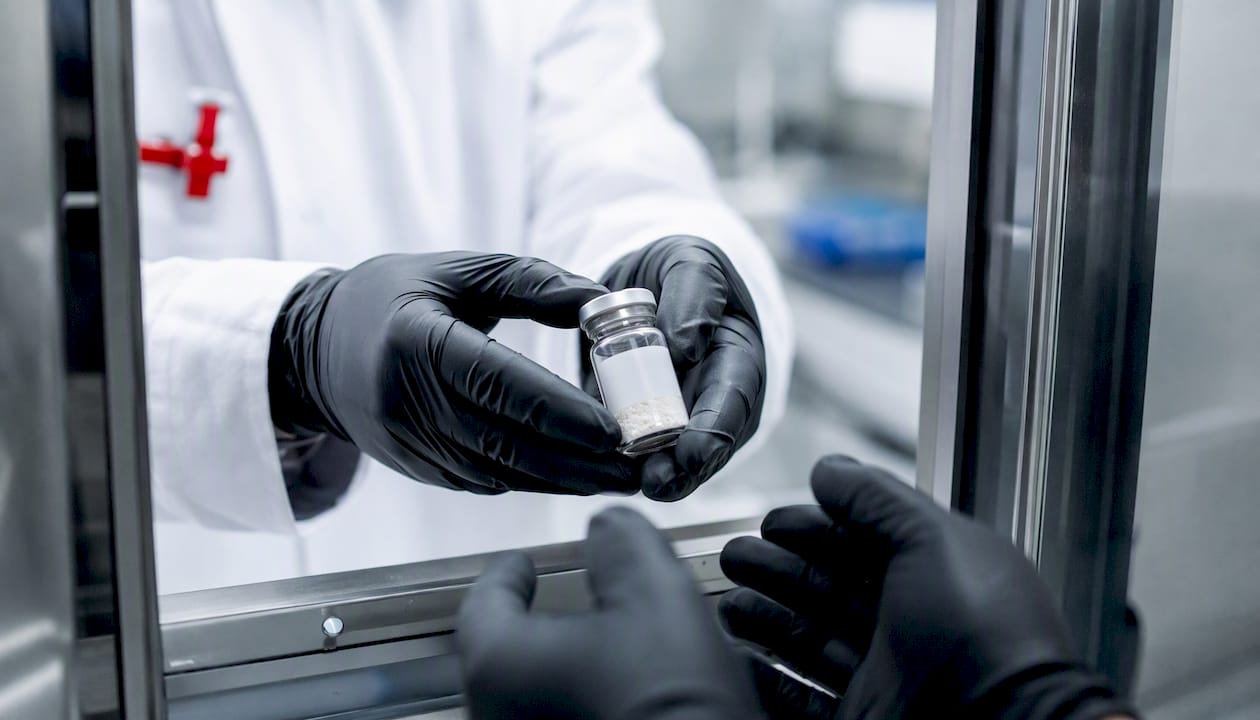
A properly completed sample chain of custody (CoC) form, with unique identifiers, dual signatures, precise timestamps, and condition notes at every transfer, is the single most reliable way to preserve sample integrity and support admissibility in Canadian legal and regulatory proceedings. You can access a blank CoC template directly through 7ohyea’s research documentation resources as a starting point for your lab or field workflow.
Before handing off any sample, confirm these three elements are in place:
Unique sample ID assigned before collection, recorded on both the container and the form
Dual signatures with timestamp (relinquishing and receiving parties, date and time to the minute)
Seal and condition note confirming packaging integrity at the moment of transfer
Pro Tip: If you cannot confirm all three elements above before a handoff, hold the transfer until you can. A missing signature or unlabeled container at step one creates a gap that no subsequent documentation can fully close.
Key Takeaways
A defensible sample chain of custody requires a unique identifier, dual signatures with precise timestamps, condition notes at every transfer, parent/child linkage for aliquots, and a closed final disposition entry.
Point | Details |
Unique ID before collection | Assign and label the sample ID before collection; never retroactively assign without a documented correction entry. |
Dual signatures at every handoff | Both relinquishing and receiving parties sign with separate timestamps at each transfer, not a shared entry. |
Condition and seal notes | Record seal status and packaging condition at every transfer; photograph seals for high-risk samples. |
Parent/child aliquot linkage | Each aliquot gets a child ID encoding the parent; document the split event on the parent CoC. |
Run a traceability drill | Ask an uninvolved colleague to reconstruct the sample history from records alone to reveal real gaps. |
Table of Contents
What is a sample chain of custody and when do you need it in Canada?
When does a sample actually need formal custody documentation?
How do you fill out the form and manage transfers correctly?
How do custody gaps affect admissibility in Canadian courts?
An editorial perspective on why CoC discipline prevents costly disputes
What is a sample chain of custody and when do you need it in Canada?
IUPAC defines chain of custody as the documented sequence of responsibility for a substance from manufacture or collection through distribution, use, and final disposition. In practice, a CoC is the chronological record of who had a sample, when, what they did with it, and what condition it was in at each transition. That distinction matters: CoC is not inventory tracking. Inventory tells you where something is now; CoC tells you everywhere it has been and who was responsible at each moment.
In Canada, formal CoC documentation is required or strongly advisable in these situations:
Forensic evidence submitted to RCMP or provincial forensic labs, where admissibility under Canadian evidence rules depends on an unbroken custody record
Clinical biospecimens subject to ethics board oversight, Health Canada regulations, or CLIA/CAP-level quality standards
Inter-institutional transfers governed by material transfer agreements (MTAs) or sponsor protocols
Controlled substance analysis, including research-grade alkaloids, where regulatory accountability is mandatory
IP-sensitive or litigation-adjacent research, where results may be contested in court or arbitration
Gaps in custody records reduce the evidentiary weight of analytical results and can affect outcomes under Canadian evidence rules. Document every anomaly and annotate it clearly rather than leaving a blank.
When does a sample actually need formal custody documentation?
Not every reagent or aliquot warrants a full CoC form. A practical rule: when results could be legally contested, tied to a sponsor agreement, or cross institutional boundaries, use full CoC documentation. Routine same-day aliquots prepared and analyzed within a single closed system by the same analyst generally do not require it.
Common scenarios that do require formal custody records:
Forensic exhibits (drug seizures, environmental samples, biological evidence)
Human biospecimens collected under ethics approval or Health Canada oversight
Research chemicals transferred between institutions under an MTA
Chain of custody for research chemicals sourced from external suppliers, where certificates of analysis must be linked to sample IDs
Controlled substance reference materials used in analytical method validation
Document your lab’s scope policy in writing. Inconsistent application, applying CoC to some samples but not others without a written rationale, is itself a defensibility risk during audits.
What fields does every sample CoC form need to capture?
CASRAI’s guidance on sample chain of custody in research labs specifies that every CoC record must capture a unique sample identifier, custodian identity, timestamp, action taken, condition or environment, and a final disposition entry. The table below maps each required field to its purpose.
Field | Purpose |
Unique sample identifier | Ties every event to one specific sample; must appear on container and form |
Sample description / matrix | Defines what the sample is and its physical state at collection |
Collector name and affiliation | Establishes the first custodian and accountability origin |
Date and time of collection | Anchors the custody timeline; record to the minute |
Relinquished by / received by | Dual-party accountability at each transfer; both parties sign |
Purpose of transfer | Documents why custody changed hands (analysis, storage, transport) |
Condition and seal status | Records packaging integrity; note any damage or broken seals |
Storage location and conditions | Temperature, container type, and physical location at each stage |
Chain endpoint / final disposition | Destruction, archiving, or return; closes the custody record |
Standards including ISO/IEC 17025 and GLP frameworks require that storage conditions and analyst identities be traceable from receipt through disposal, making every field in this table a compliance requirement, not a suggestion.
Pro Tip: When you create aliquots from a parent sample, assign each child a new identifier that encodes the parent ID (e.g., LAB-2026-047-A1, LAB-2026-047-A2). Record the split event on the parent CoC and open a new CoC for each child. Never let aliquots inherit the parent ID without a documented split entry, or traceability collapses the moment one child takes a different path.
How do you fill out the form and manage transfers correctly?
Follow these steps in sequence for every collection and handoff event.
Prepare the container and label before collection. Affix a pre-printed label with the unique sample ID, collection date, and collector name before the sample touches the container. A label added after collection is a documentation gap.
Assign the unique ID. Use a format that encodes lab code, year, and sequential number (e.g., 7OH-2026-031). Log it in your sample tracking system before leaving the collection site.
Complete the initial CoC entry at collection. Record sample description, matrix, collector name, date and time, and condition. Sign the “relinquished by” line immediately.
Apply tamper-evident seals. Photograph the sealed container before transport. Note the seal number or lot on the CoC.
Execute dual signatures at every handoff. The relinquishing party signs out; the receiving party inspects the seal, notes condition, and signs in. Both entries carry the same timestamp, recorded to the minute. ForensicSpot’s guidance on chemical evidence confirms that a single unaccounted custody gap can render analytical results vulnerable in court.
Document broken or compromised seals immediately. If a seal is broken on receipt, note it in the condition field, photograph it, and notify the sending party before proceeding. Do not proceed silently.
Correct paper errors with a line-through only. Draw a single line through the error, initial and date the correction, and write the correct information adjacent. Never use correction fluid or erase, as an auditable trail requires the original entry to remain legible.
Close the record at final disposition. Record destruction, archiving, or return with date, method, and authorizing signature.
Pro Tip: For high-risk transfers (controlled substances, forensic exhibits, IP-sensitive materials), add a witness or supervisor co-signature at the handoff. One extra signature costs seconds and can prevent a credibility challenge that costs weeks.
Blank CoC template and a filled example you can use today
A blank CoC template structured around the fields above is available through 7ohyea’s lab documentation resources. Professional organizations such as AORN publish field-tested CoC forms that include explicit lines for “relinquished by” and “received by,” date and time, item count, and badge or ID numbers, confirming that these fields appear consistently across hospital, police, and environmental monitoring contexts.
The filled example below shows a single inter-lab transfer for a research-grade alkaloid reference material.

Field | Filled Entry |
Sample ID | 7OH-2026-031 |
Sample description | 7-Hydroxymitragynine reference standard, 30 mg tablet, sealed vial |
Collector / originating custodian | Dr. A. Reyes, 7ohyea QA Lab, BC |
Date / time of collection | March 4, 2026 |
Relinquished by | Dr. A. Reyes — signed, March 4, 2026 |
Received by | M. Okafor, UBC Analytical Lab — signed, March 4, 2026 |
Purpose of transfer | External method validation, HPLC-MS |
Condition on receipt | Tamper-evident seal intact, vial undamaged |
Storage on receipt | 4°C refrigerator, Rack B, Position 12 |
Final disposition | Pending — to be updated on analysis completion |
Common mistakes this example avoids: the receiving party’s signature is timestamped separately from the relinquishing signature (they are not the same moment). The seal condition is noted explicitly, and the purpose of transfer is specific enough to link to a protocol number.
How do custody gaps affect admissibility in Canadian courts?
Canadian courts treat CoC gaps as affecting the weight of evidence more often than triggering outright exclusion, but that distinction offers less comfort than it sounds. A gap that allows a plausible argument of substitution or tampering can undermine an otherwise solid analytical result. ForensicSpot’s forensic chemistry guidance notes that even technically accurate results become vulnerable when custody documentation is incomplete.
Red flags that weaken a custody record and their immediate remediation:
Missing signatures: Obtain a late signature with a notation explaining the delay; never backdate.
Unlabeled aliquots: Assign an ID retroactively with a documented correction entry; photograph the container.
Overwritten or erased entries: These suggest tampering regardless of intent. Reconstruct the event in a separate addendum, signed and dated, referencing the original entry.
No seal documentation: Photograph existing packaging immediately and note the absence of prior seal documentation as a discovered gap.
Practical mitigation steps: preserve original packaging, maintain an immutable archive of certificates and electronic records, and run periodic traceability drills where an uninvolved staff member attempts to reconstruct the full sample history using only the records on file.
How do you make a digital CoC system defensible in Canada?
Digital CoC systems are acceptable in Canadian lab and legal contexts when they meet minimum audit requirements. Per-user authentication, immutable timestamps (recorded to the second), tamper-evident logs, and secure off-site backups are the baseline. ForensicSpot confirms that digital signatures are increasingly accepted provided the system prevents retroactive editing and timestamps each transaction precisely.
Implementation considerations for Canadian labs:
Integrate barcode or RFID scanning with your LIMS only if the system enforces per-user transactions and logs every scan as a discrete, dated event, not a location update that overwrites the prior entry.
Link supplier certificates and source documents to the sample record and version them; a reference material certification file attached to the CoC record strengthens traceability significantly.
Keep source documents versioned and linked, not just referenced by name.
Prefer paper when physical signatures across a tamper-evident seal are expected by the receiving court or agency. Hybrid workflows (paper at collection and court submission, digital for lab-internal transfers) are common and defensible when the reconciliation step is documented explicitly.
An editorial perspective on why CoC discipline prevents costly disputes
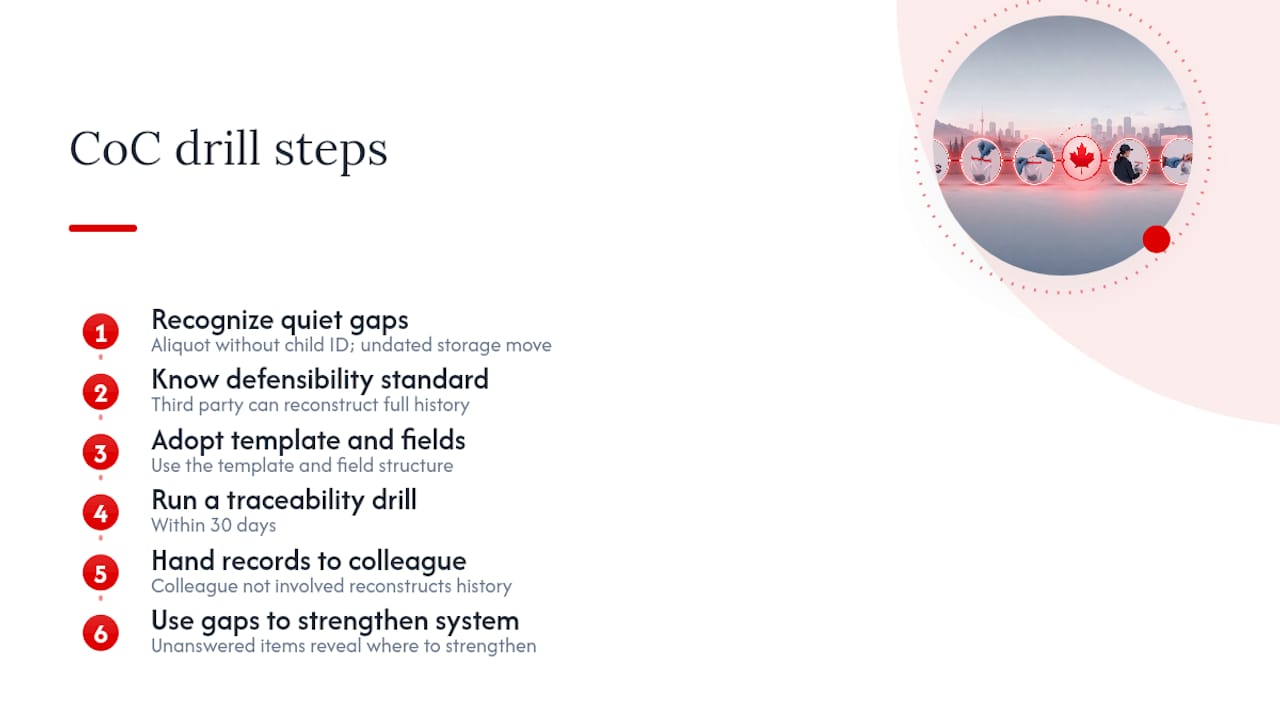
The most expensive CoC failures are not the dramatic ones. They are the quiet gaps: an aliquot split without a child ID, a storage move logged only as a current location rather than a dated event. Labcompare’s batch-traceability framework makes the point precisely: a CoC is defensible only when a third party can reconstruct the sample’s full history without relying on institutional memory. That standard is harder to meet than most labs realize until they run a traceability drill and discover the gaps themselves.
Consistent CoC practice is not bureaucratic overhead. It is the difference between a result that stands and one that gets challenged at the worst possible moment. If you adopt the template and field structure described here, run a drill within 30 days. Hand the records to a colleague who was not involved and ask them to reconstruct the sample’s history. What they cannot answer tells you exactly where to strengthen the system. For labs working with analytical-use-only materials, that discipline also directly supports regulatory compliance and audit readiness.
Sources
The sources below support the recommendations in this guide and are worth consulting for deeper implementation detail.
Link your CoC records to Certificates of Analysis and LIMS export files wherever possible. A CoC that references a certificate by lot number but cannot produce the certificate itself is only half a traceability record.
This article is general information, not a substitute for advice from a qualified lawyer. Consult a qualified legal professional about your own circumstances before acting on anything here.
FAQ
What is a sample chain of custody?
A sample chain of custody is the documented, chronological record of who possessed, transferred, and analyzed a sample from collection through final disposition, as defined by IUPAC. It establishes accountability at every stage and supports the legal or regulatory defensibility of analytical results.
How do you write a chain of custody record?
Assign a unique sample ID before collection, complete an initial entry with collector name, date, time, and condition, then obtain dual signatures (relinquishing and receiving) with precise timestamps at every subsequent transfer. Close the record with a final disposition entry signed by the last custodian.
What does a chain of custody example look like?
A typical entry records the sample ID (e.g., 7OH-2026-031), the relinquishing party’s name and signature with timestamp, the receiving party’s name and signature with a separate timestamp, the purpose of transfer, and the seal or condition status observed on receipt.
What fields must a chain of custody form include?
Every CoC form must capture a unique sample identifier, sample description, collector name, collection date and time, relinquished-by and received-by signatures with timestamps, purpose of transfer, condition and seal status, storage location, and final disposition, per CASRAI’s research lab guidance.
How do custody gaps affect results in Canadian legal proceedings?
Canadian courts typically treat CoC gaps as affecting the weight of evidence rather than triggering automatic exclusion, but a documented gap allows opposing counsel to argue substitution or tampering, which can undermine even technically accurate analytical results.
Recommended
Comments