
Reference Standard Grades: A Canadian Lab Guide
- 7OHyea
- Aug 14
- 13 min read


For regulatory batch release and compendial testing, use a primary pharmacopeial standard (USP or Ph. Eur.) or a Certified Reference Material (CRM) accredited to ISO 17034. For method validation, a well-documented CRM or qualified Reference Material (RM) is appropriate. Routine QC can rely on qualified secondary or working standards derived from a primary. Early-stage research tolerates analytical or reagent-grade materials, provided you document the limitation. The three actions to take right now:
Check your current COA for an explicit SI traceability statement and a stated measurement uncertainty, not just a bare purity percentage.
Verify your supplier holds ISO 17034 accreditation (for RM producers) or ISO/IEC 17025 (for calibration labs) — accreditation status is publicly searchable.
Schedule a qualification review for any in-house working standard that lacks a documented requalification date.
Key Takeaways
Selecting the correct reference standard grade is the single most consequential quality decision a lab makes before any analytical run, because the grade determines traceability depth, uncertainty, and audit defensibility.
Point | Details |
Match grade to regulatory context | Compendial and batch-release tests require a USP/Ph. Eur. primary or ISO 17034 CRM; research-grade materials are not substitutes. |
Verify COA completeness before use | Every COA must state the assigned value, expanded uncertainty, traceability statement, and producer accreditation number. |
Qualify and requalify working standards | Secondary standards need a documented qualification protocol and a requalification schedule tied to stability data. |
Budget for hidden ongoing costs | Requalification labor, controlled storage, and disposal costs often exceed the initial purchase price over a standard’s lifetime. |
7ohyea for alkaloid method development | 7ohyea supplies research-grade 7OH materials with COA documentation for Canadian labs initiating analytical workflows. |
Table of Contents
What are the reference standard grades and how do they rank?
How do CRMs, RMs, SRMs, and working standards actually differ?
How do you qualify a secondary working standard step by step?
Where do Canadian labs source reference standards, and what does it cost?
What labs consistently get wrong about reference standard grades
7ohyea research-grade 7OH products for Canadian analytical labs
What are the reference standard grades and how do they rank?
The five-level hierarchy runs from national metrology primary standards at the top down to research-grade chemicals at the bottom. Accuracy, traceability depth, and cost all decrease as you move down. ISO 17034 governs RM and CRM producers; ISO/IEC 17025 applies to calibration laboratories that support the chain.
Grade | Suitable applications | Traceability pedigree | Certificate type | Relative cost and lead time |
National/metrology primary (NIST SRM) | Anchor for CRM value chains, metrological research | SI-traceable; certified values with full uncertainty | COA with certified values and uncertainty | Highest cost; weeks to months |
Compendial/pharmacopeial primary (USP, Ph. Eur.) | Compendial testing, batch release, regulatory submissions | Traceable to pharmacopeial authority; assigned value with uncertainty | COA with assigned value, lot, and expiry | High cost; available via authorized distributors |
Certified Reference Material (CRM, ISO 17034) | Method validation, calibration, regulatory QC | SI-traceable or traceable to NMI/SRM; uncertainty stated | COA with assigned value, expanded uncertainty, traceability statement | Moderate to high cost; days to weeks |
Reference Material (RM, ISO 17034) | Routine QC, system suitability, method development | Supplier-assigned best estimate with uncertainty; less rigorous chain | RMIS (Reference Material Information Sheet) | Moderate cost; typically in stock |
Analytical/reagent-grade and research-grade | Early R&D, method development, non-regulated screening | No formal traceability; purity by supplier method | Information sheet or basic COA | Lowest cost; widely available |
NIST distinguishes three internal categories: Standard Reference Materials (SRMs), Reference Materials (RMs), and Research Grade Test Materials (RGTMs). SRMs represent NIST’s best assertion of metrological truth, carrying certified values, stated uncertainties, and SI traceability. RMs provide a non-certified best estimate with uncertainty. RGTMs are fit for their intended purpose, typically interlaboratory comparisons, but carry no formal certification. The SRM designation is specific to NIST; the broader term CRM applies to any ISO 17034-accredited producer’s certified material.
How do CRMs, RMs, SRMs, and working standards actually differ?
Precision in labeling matters at audit time. Calling an RM a CRM on a procurement record is a finding waiting to happen.
Term | Formal definition | Key certificate element | Qualification implication |
NIST-issued material with certified values, uncertainty, and SI traceability | COA with certified values, uncertainty, SI traceability statement | No in-lab qualification required; use as received per NIST instructions | |
CRM (ISO 17034) | Material from an accredited producer with assigned values, uncertainty, and traceability | COA with assigned value, expanded uncertainty (U, k=2), traceability statement, homogeneity/stability data | Verify COA completeness; no re-assay required if COA is complete |
Material with a best-estimate value and uncertainty; less rigorous certification | RMIS with non-certified values and supporting information | May require in-lab verification before use in regulated testing | |
Authority-issued standard for compendial tests; assigned value with uncertainty | COA with lot, assigned value, expiry, and method | Use as received for compendial tests; no re-assay required | |
In-house material qualified by comparison to a primary or CRM | Internal qualification report and COA of parent material | Full qualification protocol required; periodic requalification mandatory |
The distinction between primary and secondary standards is especially consequential in GMP environments. Primary standards are the ultimate benchmark, typically issued by pharmacopeial authorities such as USP or Ph. Eur., and are used directly for compendial tests. Secondary or working standards are qualified by direct comparison to a primary and then used for day-to-day testing to preserve the primary stock. The qualification record for a working standard must document the comparison method, the acceptance criteria, and the analyst’s approval — not just a reference to the parent COA.
A practical note on CRM quality: not all CRMs are equal. Longer traceability chains — where a producer certifies against another CRM, which was itself certified against a third material — accumulate uncertainty at each step. Prefer materials whose COA traces directly to a NIST SRM or NMI-issued primary, and check that the producer used multiple independent methods for value assignment.
When should you use each grade in a Canadian lab?
The minimum acceptable grade is set by the test’s regulatory and compendial context, not by what happens to be on the shelf. FDA guidance and ICH Q7 both require that reference standards used in analytical procedures be suitable for their intended purpose and supported by qualification data. Health Canada’s drug submission requirements align with these expectations, and inspectors reviewing a Canadian GMP facility will apply the same scrutiny.
Lab task | Minimum acceptable grade | Regulatory basis |
Compendial identity and purity testing, batch release | USP/Ph. Eur. primary or equivalent CRM | Pharmacopeial monograph; Health Canada GMP |
Regulatory method validation | CRM (ISO 17034) with stated uncertainty | ICH Q2(R1); FDA analytical methods guidance |
Stability testing (quantitative) | CRM or qualified working standard derived from CRM | ICH Q1A; GMP expectation |
Routine QC and system suitability | Qualified secondary/working standard | ICH Q7; internal SOP |
Method development and early R&D | Analytical-grade or research-grade material | Fit-for-purpose; document the limitation |
The audit risk of grade mismatch is concrete. A batch release test run against a research-grade standard with no traceability statement and no stated uncertainty gives an inspector an unambiguous finding. The documentation you must retain for each regulated test includes: the COA or RMIS with traceability statement, the producer’s accreditation certificate or number, the incoming-inspection record, and, for working standards, the full qualification report. Missing any one of these is enough to trigger a corrective action request.
Pro Tip: When Health Canada or a third-party auditor requests your reference standard files, having a single binder or electronic folder per lot — COA, accreditation evidence, incoming log, and qualification report — cuts response time from days to minutes.
How do you qualify a secondary working standard step by step?
Qualifying a working standard is a documented analytical exercise, not a formality. GMP environments require written protocols covering preparation, approval, storage, and periodic requalification. The steps below reflect ICH Q7 expectations and ISO 17034-style rigor.
Select the candidate material. Choose a high-purity lot from a reputable supplier. Obtain the full COA, including the purity assignment method and stated uncertainty. Prefer materials where purity was assigned by mass balance, qNMR, or a validated direct assay rather than by a single HPLC area-percent result.
Obtain and review the parent COA. Confirm the traceability statement links to a NIST SRM, USP primary, or equivalent NMI-issued material. Confirm the expanded uncertainty (U, k=2) is stated. Flag any missing fields before proceeding.
Perform the comparison assay. Run a validated HPLC, qNMR, or mass-balance assay comparing the candidate to the primary standard under the same conditions. Run at least three independent replicates. Calculate the assigned value and propagate uncertainty from both the primary COA and the assay.
Set and apply acceptance criteria. Define the acceptable bias (commonly ±2% for pharmaceutical QC) and the precision limit before running the assay, not after. If results fall outside criteria, investigate before approving the material.
Document and approve. Compile the qualification protocol, raw data, calculation sheet, comparison report, and analyst/supervisor signatures into a single controlled record. Assign a lot number and an approved-use date.
Define storage conditions and requalification interval. Specify temperature, light, and humidity conditions based on the material’s stability data. Set a requalification date based on that stability data, typically 12 months for solid organic standards stored at controlled room temperature, though the actual interval must be justified by data.
Monitor and requalify. At each requalification, repeat the comparison assay. Triggers for early requalification include a lot change, observed QC drift, or a storage excursion.
Pro Tip: Set a calendar alert 60 days before each working standard’s requalification date. A standard that expires mid-study without a qualified replacement in place is a protocol deviation — and a preventable one.
How do you read a COA or RMIS and spot red flags?
A certificate is only as useful as your ability to read it critically. ISO guidance defines the required content for CRM certificates: the assigned value, expanded uncertainty with coverage factor, the method(s) used for value assignment, homogeneity and stability data, and the traceability statement. An RMIS for an RM contains non-certified best-estimate values and supporting information — it is not interchangeable with a COA for regulated testing.
Fields to verify on every incoming certificate:
Assigned value and units: Confirm the value matches your method’s requirements (e.g., purity on an as-is basis vs. dried basis).
Expanded uncertainty (U) and coverage factor (k): A COA that states “99.5%” with no uncertainty is not a CRM certificate. The uncertainty tells you the confidence interval around that value.
Traceability statement: Must name the higher-order standard or NMI to which the value is traceable. “Traceable to NIST” with no further detail is weak; the specific SRM number is stronger.
Method of value assignment: qNMR, mass balance, HPLC, or thermal methods each carry different uncertainty profiles. The method must be stated.
Lot number and expiry or retest date: Never use a material past its stated expiry without a documented retest.
Homogeneity and stability data: Required for CRMs; absence is a red flag for materials claimed as CRM-grade.
Producer accreditation number: ISO 17034 for RM producers; ISO/IEC 17025 for calibration labs. Verify the number against the accreditation body’s public registry. For Canadian labs, understanding the difference between ISO 17034 and ISO/IEC 17025 is a practical first step.
Red flags that warrant rejection or escalation: no stated uncertainty, no traceability statement, analyte identity that does not match your method’s target, storage conditions on the COA inconsistent with how the material was shipped, or unexplained large impurity peaks in the chromatographic data. Log every incoming-certificate check in your materials management system, including the reviewer’s name, date, and disposition decision.
Where do Canadian labs source reference standards, and what does it cost?
Sourcing the right grade from a verified supplier is as important as selecting the grade itself. For NIST SRMs, Canadian labs order through NIST’s authorized distribution channels or directly from NIST; confirm the distributor’s authorization in writing and request the original NIST COA, not a distributor-generated copy. USP Reference Standards are available through USP’s own store and authorized distributors operating in Canada; always verify the lot matches the COA you receive. Merck/Sigma-Aldrich maintains Canadian distribution and stocks a broad catalog of CRMs and RMs, though you should confirm the COA version corresponds to the specific lot shipped and that the traceability statement names a recognized NMI.
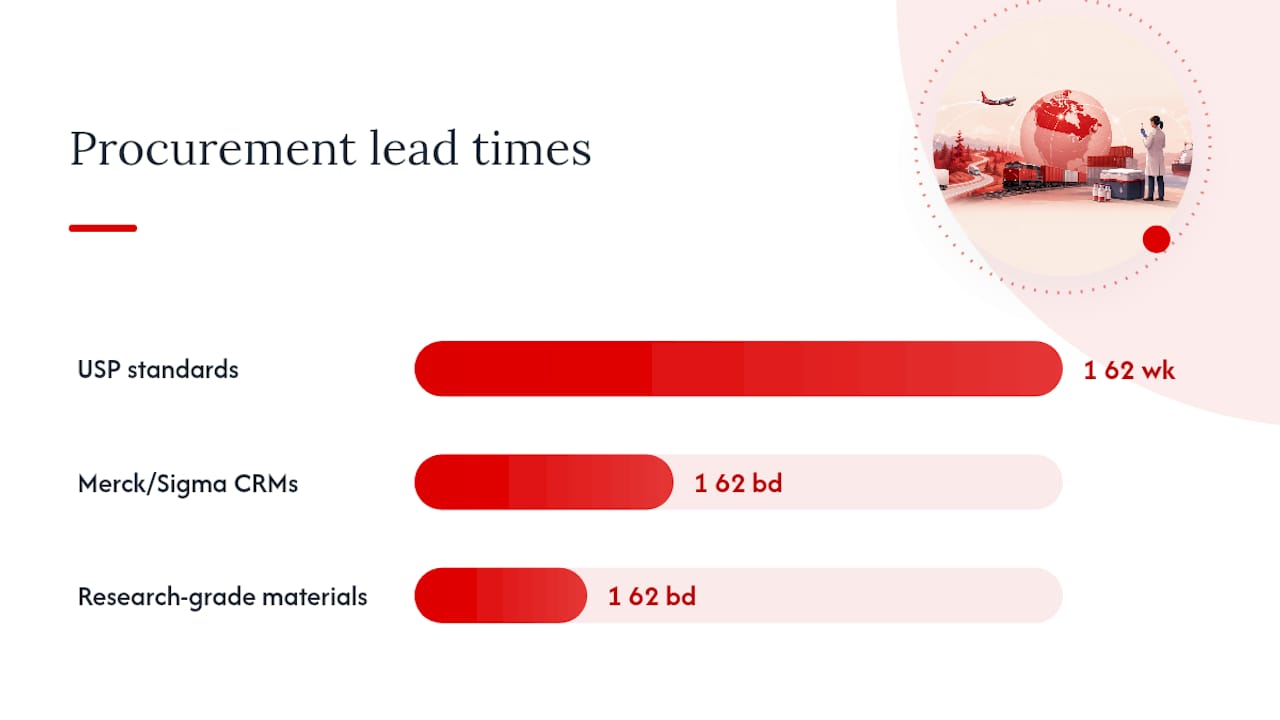
Procurement lead times vary significantly by grade. NIST SRMs can take several weeks to months, particularly for specialty materials. USP pharmacopeial standards are generally available within one to two weeks through authorized distributors. Commercial CRMs from Merck/Sigma-Aldrich are often in stock for common analytes, with one to five business days for domestic Canadian shipment. Research-grade materials are typically available within one to three business days.
The direct cost of a primary pharmacopeial standard or NIST SRM is often the smallest part of the total budget. Hidden and ongoing costs include:
Controlled storage: Refrigerated or frozen storage for temperature-sensitive standards adds equipment and energy costs, plus monitoring and logging requirements.
Periodic requalification: Each requalification cycle requires analyst time, instrument time, and documentation review — typically two to four hours of skilled labor per working standard per cycle.
Stability retesting: If your stability data does not support the full intended use period, you may need to fund additional stability studies.
Waste and disposal: Expired or rejected standards require documented disposal, which may carry regulatory costs for controlled or hazardous materials.
Administrative overhead: Maintaining a compliant materials management system, including incoming logs, qualification records, and requalification schedules, is a recurring labor cost that labs often underestimate.
For traceability documentation specific to Canadian lab requirements, building a procurement checklist that captures all of these cost drivers before the purchase order is issued prevents budget surprises mid-study.
A quick decision checklist for choosing the right grade
Use this flow at the procurement desk or before starting a new method:
Is the test compendial or required for regulatory submission? If yes, you need a USP/Ph. Eur. primary or an ISO 17034-accredited CRM. Do not substitute an RM or research-grade material.
Is SI traceability explicitly required by your SOP or the applicable guidance? If yes, confirm the COA names the NMI or SRM to which the value is traceable.
Is an assigned uncertainty documented on the COA? If no uncertainty is stated, the material cannot be used for quantitative regulated testing without additional in-lab characterization.
Do you have a validated qualification method in-house? If yes, a qualified working standard derived from a CRM is acceptable for routine QC. If no, you must use the CRM directly until the method is validated.
Is the test for method development or early R&D only? If yes, analytical-grade or research-grade material is acceptable, provided you document the grade and its limitations in the study record.
Minimum documentation for every procurement: COA or RMIS, producer accreditation certificate or number, incoming-inspection record, and (for working standards) the full qualification report.
What labs consistently get wrong about reference standard grades
The most persistent audit finding in Canadian pharmaceutical QC labs is not a missing COA. It is a COA that is present but unread. Analysts accept a certificate because it exists, without checking whether the traceability statement actually names a recognized NMI, whether the uncertainty is stated in a form that supports the test’s precision requirements, or whether the lot on the certificate matches the lot on the vial. These are not obscure metrological subtleties. They are the first three fields any auditor will check.
The second most common issue is the working standard with no requalification record. A lab qualifies a secondary standard correctly at the start of a project, then continues using it for 18 months with no documented recheck. The stability data supporting the original qualification covered 12 months. The standard may still be fine, but the lab cannot demonstrate that, and the auditor does not have to take their word for it.
Practical fixes that most labs can implement within two weeks: create a one-page incoming-certificate checklist (assigned value, uncertainty, traceability statement, lot match, expiry, accreditation number) and make it a required attachment to every materials receipt record. Set up a simple spreadsheet or LIMS flag that shows every working standard’s next requalification date 60 days in advance. Verify your top five suppliers’ ISO 17034 accreditation status against the accreditation body’s public registry this week, not at the next audit.

7ohyea research-grade 7OH products for Canadian analytical labs
For labs working with mitragynine alkaloids, 7ohyea supplies research-grade 7-hydroxymitragynine (7OH) tablets and powders sourced and manufactured in British Columbia, positioned at the research-grade tier of the reference material hierarchy. These materials are intended strictly for analytical and laboratory use, not for human consumption, and are not positioned as ISO 17034-certified CRMs for regulatory batch release.
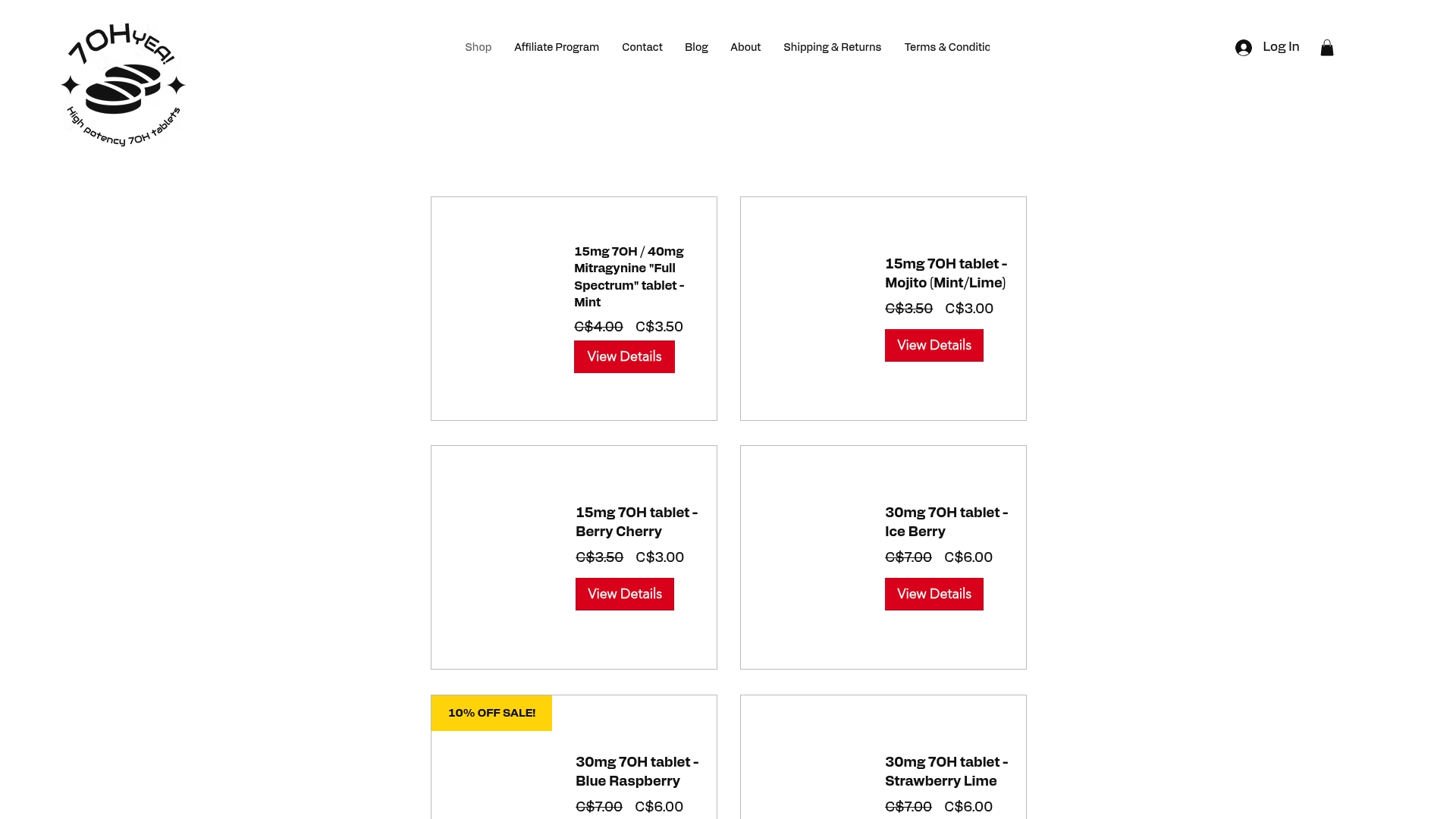
Each shipment from 7ohyea includes a Certificate of Analysis stating the lot number, purity assay method, and assigned purity value, giving your lab the documentation baseline needed to initiate an in-house qualification workflow. Dosage options support a range of analytical protocols, and domestic sourcing from British Columbia means typical lead times of one to three business days for Canadian labs. For labs developing detection methods for 7-hydroxymitragynine, having a consistent, well-documented starting material is the practical first step before moving to a higher-grade certified standard. Labs that need bulk material for spiking or calibration curve work can review the 83% pure 7OH powder option. To review available lots and COA documentation, visit 7ohyea and contact the team directly for procurement inquiries.
Sources
The following primary references are worth downloading and citing in your SOPs and audit packs:
FAQ
What is the difference between a reference standard and a primary standard?
A reference standard is a broad term covering any material used to calibrate instruments or validate analytical methods. A primary standard specifically refers to a material of the highest metrological quality, typically issued by a pharmacopeial authority (such as USP) or a national metrology institute (such as NIST), carrying certified values with stated uncertainty and SI traceability.
What is a Certified Reference Material (CRM)?
A CRM is a reference material produced by an ISO 17034-accredited producer, with assigned values, stated expanded uncertainty, and a documented traceability chain to SI units or a recognized higher-order standard. The COA must include all of these elements; a certificate missing uncertainty or a traceability statement does not meet the CRM definition.
What are some examples of reference standards used in pharmaceutical labs?
USP pharmacopeial reference standards are the most widely used in Canadian pharmaceutical QC for compendial testing. NIST SRMs serve as the metrological anchor for CRM value chains. Commercial CRMs from suppliers such as Merck/Sigma-Aldrich cover a broad range of organic and inorganic analytes for method validation and routine QC.
What is a Reference Material Information Sheet (RMIS) and how does it differ from a COA?
An RMIS accompanies a Reference Material (RM) and contains non-certified best-estimate values and supporting information. Unlike a COA for a CRM, an RMIS does not carry formally certified values or the full uncertainty budget required for regulated quantitative testing. An RMIS is appropriate for routine QC and system suitability but not for compendial batch release.
How often should secondary working standards be requalified?
Requalification intervals must be justified by stability data for the specific material and storage conditions. A 12-month interval is common for solid organic standards stored at controlled room temperature, but the interval should be shortened if QC data shows drift, if a lot change occurs, or if a storage excursion is documented.
Recommended
Comments