
Powder flow 7OH: a stability-aware testing protocol
- 7OHyea
- Aug 16
- 6 min read

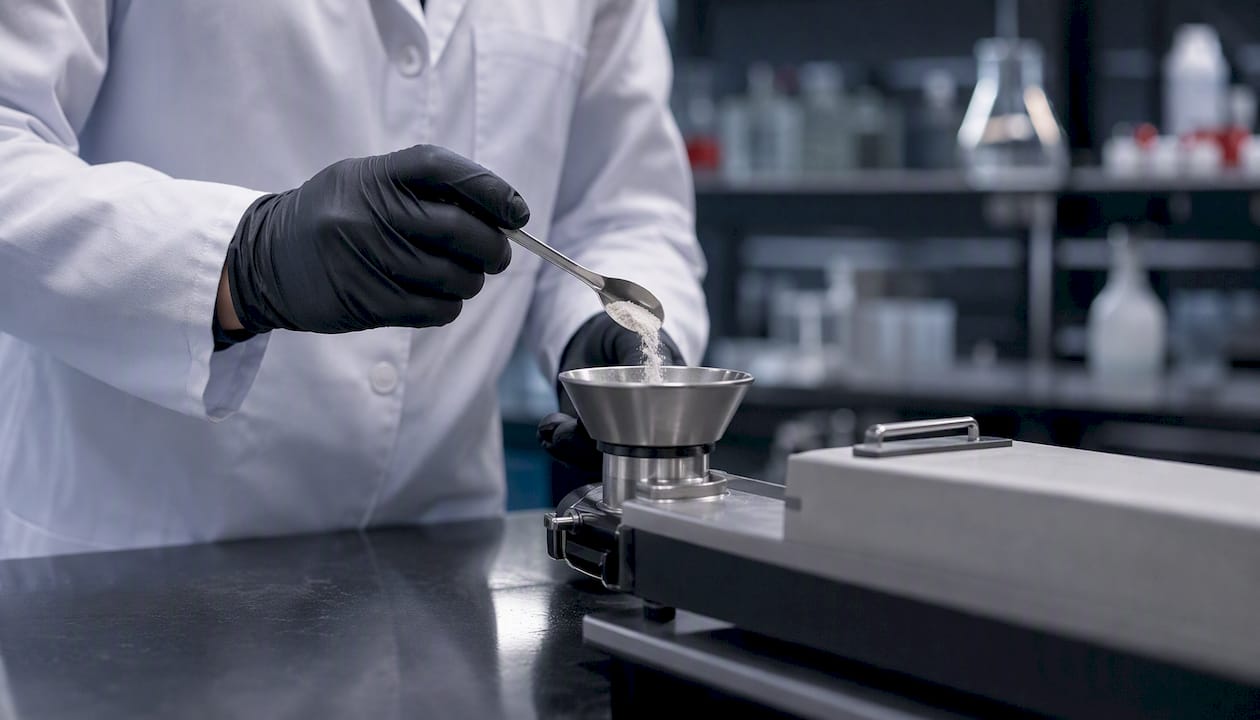
Run a complementary battery, not a single test: dynamic powder rheometry on an FT4-type instrument, a flow-through-orifice aperture curve fitted to the Beverloo model, shear cell testing for cohesive behaviour, and quick QC indices (Carr index, Hausner ratio, angle of repose) as a screening layer before committing instrument time. That combination is what the powder flowability literature consistently points to, because no single method captures the full behaviour of a cohesive, alkaloid-rich powder like 7-hydroxymitragynine (7-OH).
Before any of that data means anything, though, you need to control for something most flow protocols never mention: 7-OH’s own chemical instability. Its degradation is solvent and pH dependent, and under simulated gastric or certain solvent conditions it can form 3-dehydromitragynine, a degradation product that can quietly confound both your analytical results and your physical measurements if it forms during sample prep.
Here is the minimum viable protocol for a defensible dataset:
Run n≥3 independent replicates per condition, minimum, and report them individually rather than pooling to a single mean.
Condition samples at a documented relative humidity and temperature before every test run, and hold those parameters constant across replicates.
Report bulk density and tapped density alongside every flow metric, since Carr and Hausner calculations are meaningless without them.
Log solvent contact time, pH, and light exposure for every step where the powder touches anything but dry air.
Pro Tip: Run an UHPLC‑PDA‑MS check on a conditioned aliquot before you finalize your flow dataset. If a degradation peak shows up after conditioning that wasn’t present in the unconditioned reference, your flow numbers may reflect an artefact, not the compound you think you’re testing.
Table of Contents
Why powder flow measurement matters for 7-OH research
Powder flow behaviour is not a side detail in 7-OH studies. It is the mechanism that determines whether your subsamples are actually representative of the batch, whether your extraction yields are reproducible, and whether the alkaloid concentration you report reflects the real material or an artefact of poor mixing.
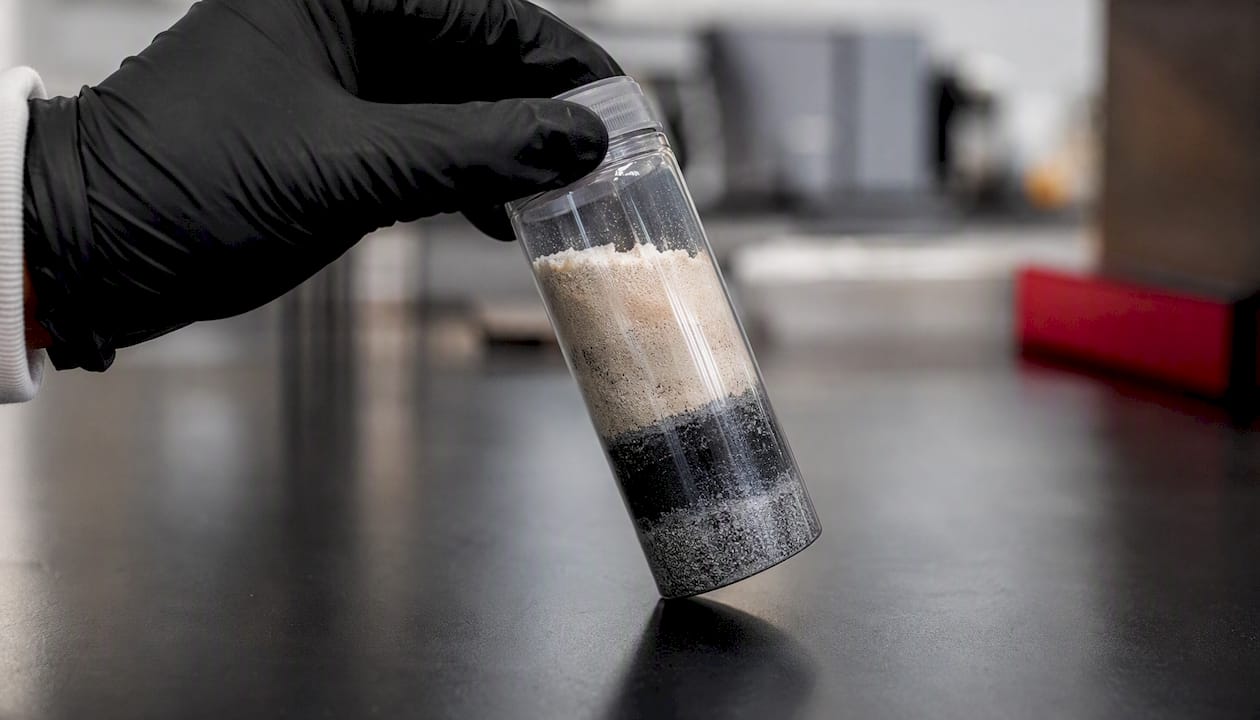
A powder that flows unevenly segregates by particle size and density during handling. Finer, denser particles migrate to the bottom of a container; coarser or lighter fractions ride to the top. Pull a sample from the wrong spot in a segregated batch of 7-OH powder, and your reported purity or dosage figure can drift from the true batch average without any instrument error at all.
The scale of the problem across the powder-handling industry is not trivial. Powders are estimated to constitute a large share of the materials handled across industrial manufacturing, and inconsistent flow behaviour is a recurring source of production downtime, segregation, and dosing error in that broader context. Pharmaceutical and analytical labs inherit the same physics, just at a smaller scale and with tighter tolerances.
For 7-OH specifically, poor flow characterization creates three concrete failure modes:
Non-representative subsampling — pulling from a segregated container gives you a sample that doesn’t match the batch’s true alkaloid distribution.
Variable extraction efficiency — cohesive powders with poor flow often pack unevenly into extraction vessels, changing solvent contact area and yield between replicates.
Increased degradation exposure — powders that resist flow tend to require more manual handling, more scooping, more solvent-assisted transfer, and each of those steps is another opportunity for pH or solvent exposure to trigger the instability discussed below.
Chemical stability risks during sampling and testing
The core fact to internalize before you touch a 7-OH powder sample: it is chemically unstable under specific, identifiable conditions. Degradation is solvent- and pH-dependent, and simulated gastric conditions in particular have been shown to drive formation of 3-dehydromitragynine. That transformation matters for powder-flow researchers for a subtle reason: a sample that degrades mid-protocol is no longer the material you set out to characterize, yet its physical flow properties may look entirely normal.
That disconnect is the trap. A flow rheometer has no way of telling you the sample chemically changed between conditioning and testing. Only an orthogonal analytical check can do that.
Practical controls worth building into your standard operating procedure:
Avoid prolonged solvent exposure during any wet-sieving or dispersion step; document exact contact time down to the minute.
Use neutral buffers rather than low-pH solutions wherever a buffer choice exists in your workflow, and flag any protocol step that can’t avoid acidic conditions.
Minimize heating during drying steps; forced air at ambient temperature beats an oven whenever the timeline allows it.
Keep samples out of direct light during conditioning and storage, and log exposure duration for anything that can’t be shielded.
Run a stability check via UHPLC-PDA-MS on at least one conditioned aliquot per batch before you commit to a full flow-testing run.
Pro Tip: If your conditioning protocol requires air drying after solvent exposure, document the drying kinetics explicitly and include a blank matrix control. That control is what lets you distinguish a genuine degradation peak from a solvent-residue artefact when you review the chromatogram later.
Which flow measurement methods should you actually use?
Different instruments answer different questions, and picking the wrong one for a cohesive alkaloid powder wastes both sample and time. Here is what each method uniquely tells you about 7-OH.
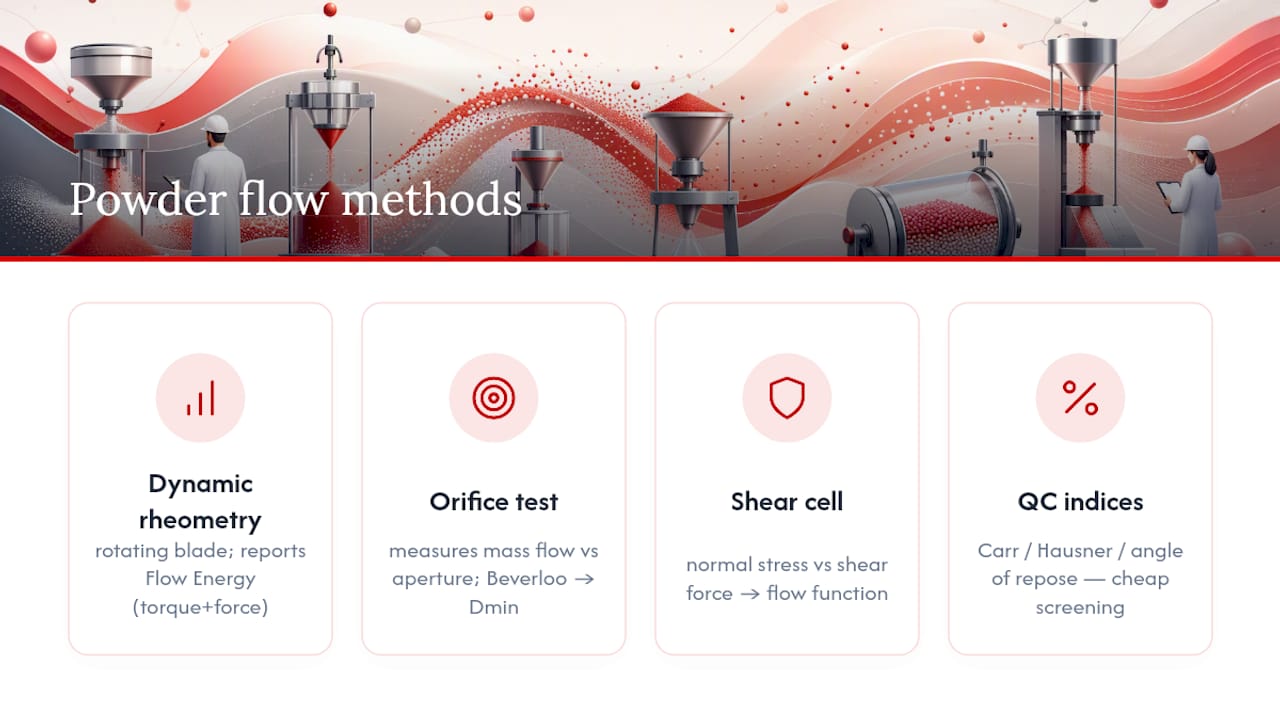
Dynamic powder rheometry (FT4-type instruments) measures resistance to powder movement using a rotating blade that traverses the sample bed. The FT4 reports both torque and force and combines them into a composite Flow Energy value, which is the metric that tells you how a cohesive powder behaves when it’s actively disturbed rather than sitting static. That distinction matters because roughly 90% of the total resistance measured in rotational tests tends to come from torque rather than the vertical force component, so an instrument that only measures one axis will understate a cohesive powder’s true resistance to flow.
Flow-through-orifice testing (automated systems like GranuFlow) measures mass flow rate through a series of aperture sizes and fits the resulting curve to the Beverloo model. This is the method that gives you Dmin, the minimum aperture diameter at which the powder will flow reliably, a number with direct engineering value if you’re designing a hopper, feeder, or dosing chute for a scaled-up study.
Shear cell testing applies a controlled normal stress and measures the shear force needed to initiate flow, producing a flow function that describes cohesive strength across a range of consolidation states. This is your go-to method when a powder is cohesive enough that simple funnel-based tests either jam or produce inconsistent readings.
Quick QC indices (Carr index, Hausner ratio, angle of repose) are the cheapest screening tools in the kit. They won’t capture flow-speed dependence or predict hopper design parameters, but they’re fast enough to run on every batch before you commit instrument time to the more demanding methods.
Pro Tip: Run at least one dynamic method (FT4 or equivalent) alongside one orifice or shear method. Relying on QC indices alone will miss flow-speed dependence, and that gap is exactly where predictive engineering outcomes go wrong when you try to scale a lab protocol to pilot equipment.
A stepwise protocol for characterizing 7-OH powder flow
Follow this sequence: log and verify identity, measure particle size and density, condition at defined humidity and temperature, run quick QC indices, confirm chemical integrity via UHPLC, then move to dynamic and orifice or shear testing in that order.
Receive and log the sample. Record supplier, lot number, and receipt date before opening the container.
Verify identity and purity. Confirm the material matches its certificate of analysis using mass spectrometry.
Measure particle size distribution. Document D10, D50, and D90 values, since particle size drives most cohesive behaviour in fine alkaloid powders.
Record bulk and tapped density. These feed directly into your Carr and Hausner calculations later.
Condition the sample. Hold at a fixed relative humidity and temperature for a defined period, documented in your notebook.
Run quick QC indices. Carr index, Hausner ratio, and angle of repose as a screening pass.
Run UHPLC-PDA-MS on a conditioned aliquot. Confirm no degradation occurred during conditioning before you invest time in dynamic testing.
Run dynamic rheometry and orifice/shear testing. In that order, since dynamic tests are less destructive to sample structure than shear consolidation.
A reporting checklist worth pinning above your bench: instrument model and firmware version, exact conditioning RH and temperature, replicate count, aperture sizes tested, blade tip speed and settings for FT4-type runs, and the specific UHPLC method reference used for the integrity check. Reviewers and future replicators need all of it.
Reading the results and spotting measurement artefacts
Flow energy trends tell you how a powder resists disturbance, not how it sits at rest. A
This article is general information, not a substitute for advice from a qualified doctor. Consult a qualified healthcare professional about your own circumstances before acting on anything here.
Sources
Recommended
Comments