
Mitragynine vs 7-Hydroxymitragynine: What Canadian Labs Need to Know
- 7OHyea
- Jul 29
- 9 min read

7-hydroxymitragynine (7-OH) is the higher-potency μ-opioid receptor (MOR) ligand of the two kratom alkaloids, with roughly 99-fold lower Ki than mitragynine in human MOR binding assays, and it functions primarily as an active metabolite produced from mitragynine via CYP3A-mediated oxidation in vivo. For Canadian labs, 7ohyea supplies research-grade 7-OH powders and tablets with batch certificates of analysis (COAs) and domestic fulfillment from British Columbia.
TL;DR
7-OH has substantially higher MOR affinity and acts as a partial agonist; mitragynine behaves as an MOR antagonist in vitro at human receptors.
Mitragynine is the parent compound; much of its in vivo analgesic activity depends on conversion to 7-OH by CYP3A enzymes.
Canadian labs can source research-grade material domestically through 7ohyea, with COAs and safety data sheets (SDS) included.
Table of Contents
What does the mitragynine-to-7-OH conversion mean for your study design?
What are the abuse liability and safety signals for each alkaloid?
Which analytical methods work best for quantifying these alkaloids?
What must you verify before accepting a batch of research-grade alkaloids?
How does domestic sourcing simplify procurement for Canadian labs?
What research-grade products does 7ohyea offer Canadian labs?
How should you store, handle, and dispose of these alkaloids in a Canadian lab?
Research-grade 7-OH and mitragynine, ready for Canadian labs
How do mitragynine and 7-OH compare pharmacologically?
The receptor data are unambiguous. In [35S]GTPγS functional assays, mitragynine acts as an MOR antagonist at human receptors, while 7-OH is a partial agonist with an Emax of 41.3%. Ki values from the same study place mitragynine at 7,709 nM versus 77.9 nM for 7-OH, a roughly 99-fold affinity difference. One review reports 7-OH possesses 46 times more MOR affinity than mitragynine and 13 times higher affinity than morphine.
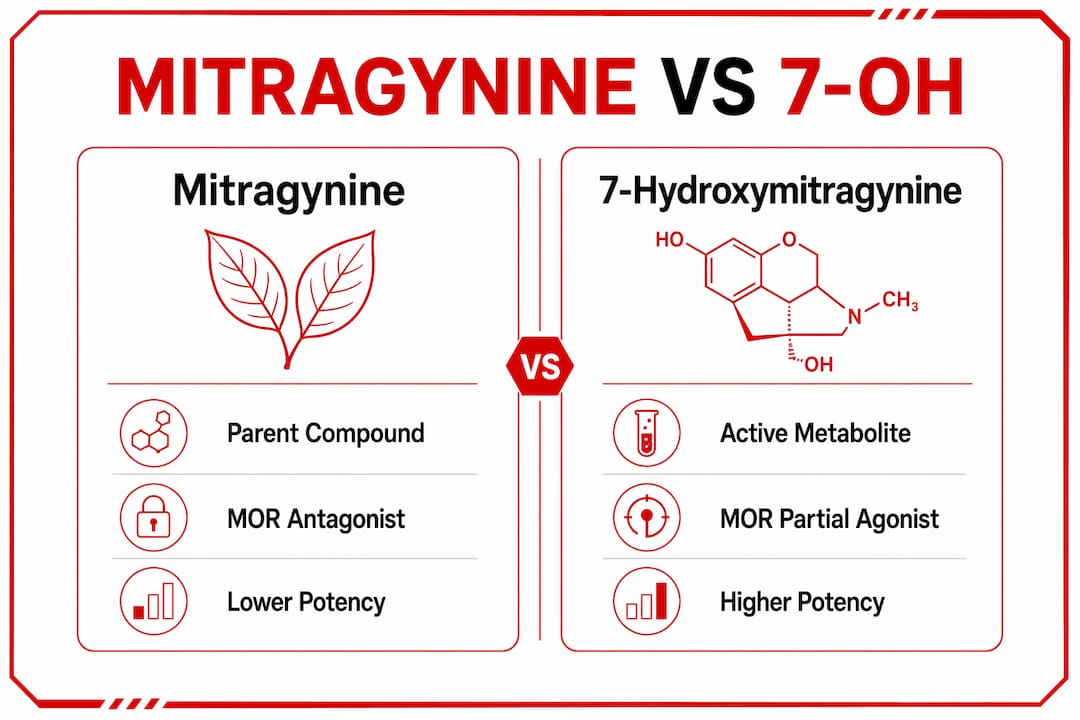
Both alkaloids show G-protein signaling bias with minimal β-arrestin recruitment, a profile that has attracted interest as a potential path toward analgesic leads with reduced respiratory-depression risk. In antinociception assays in rats, 7-OH produced measurable pain relief; mitragynine did not. Mitragynine’s in vivo pharmacology is more complex, combining low-efficacy MOR activity with interactions at adrenergic and serotonergic receptors.
Pro Tip: When designing functional selectivity experiments, report both G-protein (GTPγS) and β-arrestin recruitment endpoints. Omitting one arm makes it impossible to confirm bias and limits the interpretability of your data across labs.
What does the mitragynine-to-7-OH conversion mean for your study design?
Mitragynine is metabolized to 7-OH by CYP3A enzymes in vitro and in animal models, and this conversion is a primary driver of observed in vivo opioid effects. Intersubject variability in CYP3A activity means that two subjects receiving identical mitragynine doses can produce very different 7-OH exposures, complicating dose-response interpretation.
Parameter | Mitragynine | 7-Hydroxymitragynine |
Role | Parent compound | Active metabolite |
Primary converting enzyme | CYP3A | N/A (product) |
Research material source | Extraction or synthesis | Controlled oxidation of mitragynine |
Stability | Stable across pH 2–10 | Unstable above 40°C after 8 hours |
Because 7-OH occurs at very low levels in some commercial products, plant-derived material rarely provides sufficient 7-OH for controlled dosing studies. High-purity 7-OH for research is produced by controlled oxidation of mitragynine, a process that requires rigorous QA to confirm product integrity.
Pro Tip: In any in vivo study using mitragynine, include a parallel arm measuring plasma 7-OH concentrations via LC-MS/MS. Without that data, you cannot distinguish parent-compound effects from metabolite-driven effects, and your results will be difficult to replicate.
What are the abuse liability and safety signals for each alkaloid?
The preclinical distinction here is sharp. 7-OH shows abuse liability in rodent models and can increase morphine self-administration, whereas mitragynine generally lacks abuse liability and may reduce morphine reinforcement. Repeated 7-OH administration produces antinociceptive tolerance, cross-tolerance to morphine, and physical dependence in preclinical models.
Key safety monitoring steps for protocols involving 7-OH:
Include naltrexone reversal controls to confirm MOR-mediated effects.
Monitor withdrawal signs after repeated dosing (e.g., weight loss, paw tremors in rodent models).
Define humane endpoints and dose-ranging steps before the study begins.
Flag potential QT-interval effects in cardiovascular monitoring plans; long-term cardiac data remain limited.
Document tolerance development across dosing days with predefined criteria for dose adjustment.
Mitragynine’s safety profile in controlled human studies shows that doses of 5–40 mg were well tolerated, with low doses producing mild stimulant-like effects and the 40 mg dose associated with subjective amnesia and psychological distress. These findings are relevant context for designing human pharmacokinetic studies.
How do CYP interactions affect co-administration protocols?
Both alkaloids inhibit cytochrome P450 enzymes in vitro, creating meaningful drug-drug interaction (DDI) risk when co-administered with CYP3A substrates. Because CYP3A also mediates the mitragynine-to-7-OH conversion, CYP3A inhibition by either compound can alter the metabolite ratio in ways that confound pharmacodynamic endpoints.
DDI documentation checklist for study reports:
Run CYP inhibition panels (CYP3A4, CYP2D6, CYP2C9 at minimum) in human liver microsomes.
Report IC50 values for each enzyme tested.
Avoid co-dosing with strong CYP3A substrates unless the interaction is the study’s primary endpoint.
Document metabolic clearance data before advancing to in vivo phases.
Pro Tip: Use recombinant CYP enzymes alongside human liver microsomes. Recombinant systems let you attribute inhibition to a specific isoform, which strengthens the mechanistic argument in your study report and satisfies most institutional review requirements.
Which analytical methods work best for quantifying these alkaloids?
LC-MS/MS is the gold standard for both mitragynine and 7-OH in biological matrices. One published pharmacokinetic study used LC-MS/MS with lower limits of quantitation of 0.10 ng/mL for mitragynine and 0.09 ng/mL for 7-OH in serum, with calibration ranges of 0.2–200 ng/mL and 0.1–100 ng/mL respectively. HPLC-UV is acceptable for bulk QA of reference powders but lacks the sensitivity needed for plasma or tissue work.
Method checklist:
Sample extraction: solid-phase extraction (SPE) or protein precipitation with ethyl acetate/methyl tert-butyl ether (80:20 v/v).
Chromatographic separation: reverse-phase C18 column with gradient elution to resolve mitragynine and 7-OH.
MS transitions: monitor parent-to-product ion pairs for each compound; confirm with a second qualifier transition.
Internal standards: use isotopically labeled analogs (deuterated mitragynine and 7-OH) to correct for matrix effects and recovery variability.
Validate LOQ, LOD, recovery, and matrix effects in each biological matrix before use.
Because kratom products show chemotype variability across commercial sources, labs working with plant-derived material should run full alkaloid profiling on each batch rather than assuming consistent composition. For laboratory detection methods specific to 7-OH in Canadian lab contexts, 7ohyea publishes detailed method guidance on its site.
What must you verify before accepting a batch of research-grade alkaloids?
A COA and batch test results are non-negotiable for any research-grade material. Chemotype variability across sources means that a COA from a previous lot does not guarantee the current lot’s profile.
Minimum COA items to request:
Identity confirmation (NMR and MS)
Purity percentage (HPLC or LC-MS/MS)
Related alkaloid profile (full panel, not just the target compound)
Residual solvents (ICH Q3C limits)
Microbial limits
Water content (Karl Fischer)
Stability data and expiration date
Lot number and manufacturing site
Purchase-ready document request list:
Batch COA (identity, purity, related substances)
SDS / MSDS
Stability report and recommended storage conditions
Chain-of-custody documentation
Third-party testing confirmation where available
Requesting full alkaloid profiling on COAs improves reproducibility across experiments, particularly when comparing results between labs or replicating published studies.
How does domestic sourcing simplify procurement for Canadian labs?
Domestic sourcing reduces customs complexity and shortens lead times for controlled lab orders. A shipment originating within Canada avoids import documentation requirements that apply to cross-border chemical shipments, and it keeps chain-of-custody paperwork straightforward for institutional compliance offices.
Procurement flow for Canadian labs:
Obtain institutional approval (Research Ethics Board or biosafety committee, as applicable).
Issue a purchase order specifying research-only use, required purity, and documentation requirements.
Review the COA and SDS before accepting delivery.
Confirm shipping conditions (cold chain if required) and verify packaging integrity on receipt.
File COA, SDS, and chain-of-custody records in the lab’s chemical inventory system.
Pro Tip: Include explicit “for research use only, not for human consumption” language in your purchase order. This wording aligns with supplier documentation and supports your institutional compliance records.
Note: This section provides procurement and lab compliance guidance only. Consult your institutional compliance office for regulatory questions specific to your facility and jurisdiction.
What research-grade products does 7ohyea offer Canadian labs?
7ohyea supplies both 7-OH and mitragynine reference materials in formats suited to different experimental needs, all sourced and fulfilled domestically from British Columbia.
Product Form | Purity / Strength | Recommended Use Case |
93% pure | Analytical standard, spike-in, QC reference |
| 7-OH powder | — | Larger-quantity dosing studies, method development |
| 7-OH tablet | — | Defined-dose in vivo model support |
| Full-spectrum tablet | — | Comparative or metabolite-ratio studies |
| Mitragynine powder | — | Parent compound reference, CYP conversion studies |
All products ship with COAs and SDS documentation. Request batch COAs before accepting delivery to confirm lot-specific purity and identity data.
Pro Tip: For analytical reference work, the 93% pure 7-OH powder provides the tightest purity specification and is the most appropriate choice for spike-in calibration or method validation. Reserve lower-purity lots for dosing studies where exact stoichiometry is less critical.
How should you store, handle, and dispose of these alkaloids in a Canadian lab?
Store research-grade alkaloids in a cool, dark, desiccated environment per SDS instructions. 7-OH is notably less stable than mitragynine at elevated temperatures, showing measurable degradation after 8 hours at 40°C. Mitragynine remains stable across a wide pH range (2–10) under refrigerated conditions.
Handling and PPE:
Wear nitrile gloves, lab coat, and safety glasses when weighing or transferring material.
Weigh powders in a ventilated balance enclosure to prevent inhalation.
In case of spill, contain with absorbent material and dispose via institutional hazardous waste stream.
Post emergency contact numbers (institutional safety office, Poison Control: 1-800-268-9017 in Ontario; check your provincial authority) near the storage area.
Disposal checklist:
Do not dispose of alkaloid solutions via municipal drains.
Collect waste in labeled, sealed containers per your institution’s hazardous waste protocol.
Complete disposal paperwork with lot number, quantity, and disposal date.
Quarantine any open lot lacking current stability data until testing is completed or the lot is disposed of.
Label verification on receipt and storing the COA with each batch are minimum requirements for traceability in any auditable lab environment.
Key Takeaways
7-OH is the higher-potency MOR partial agonist and primary active metabolite of mitragynine; both compounds require careful analytical monitoring and verified COAs for reproducible research.
Point | Details |
Potency difference | 7-OH has roughly 99-fold higher MOR affinity (Ki 77.9 nM vs 7,709 nM) and is a partial agonist; mitragynine is an MOR antagonist in vitro. |
Metabolic relationship | CYP3A converts mitragynine to 7-OH in vivo; monitor plasma 7-OH levels in any in vivo mitragynine study. |
Analytical method | LC-MS/MS is the gold standard, with validated LOQ/LOD and isotopically labeled internal standards required for plasma matrices. |
Safety distinction | 7-OH shows preclinical abuse liability and produces tolerance and dependence; mitragynine generally lacks these signals. |
7ohyea sourcing | 7ohyea supplies 93% and — 7-OH powders and 15–50 mg tablets with batch COAs and SDS from British Columbia. |
Why purity documentation matters more than potency claims
The pharmacology literature on mitragynine vs 7-hydroxymitragynine is clear on one point: the difference in MOR efficacy between these two alkaloids is large enough that even modest contamination of a mitragynine reference sample with 7-OH can shift your results meaningfully. A mitragynine lot at 98% purity with 2% 7-OH contamination is not the same experiment as a clean mitragynine lot, and the difference will show up in your GTPγS data before it shows up in your behavioral endpoints.
What gets underestimated in procurement decisions is how much the COA format matters. A purity percentage alone tells you nothing about the related alkaloid profile. Labs that request only a single-compound purity figure and skip the full alkaloid panel are routinely working with material whose 7-OH content is unknown. Given that 7-OH is pharmacologically active at concentrations well below what standard HPLC-UV can reliably detect, that gap in documentation is a reproducibility problem waiting to surface.
The domestic sourcing advantage for Canadian labs is not just about lead times. It is about having a supplier whose documentation chain is straightforward to audit, whose SDS is written to Canadian workplace standards, and whose batch records are accessible when an institutional compliance review asks for them. That administrative clarity has real value in a research environment where a single missing document can delay a study approval.
Research-grade 7-OH and mitragynine, ready for Canadian labs
7ohyea provides research-grade 7-hydroxymitragynine and mitragynine reference materials with full batch COAs, SDS documentation, and domestic fulfillment from British Columbia. Whether your protocol calls for a 93% pure 7-OH powder for analytical standards or a defined-dose tablet for in vivo model support, the product range covers the most common research configurations. Bulk and institutional orders are accommodated, and COA requests can be submitted at the time of ordering.
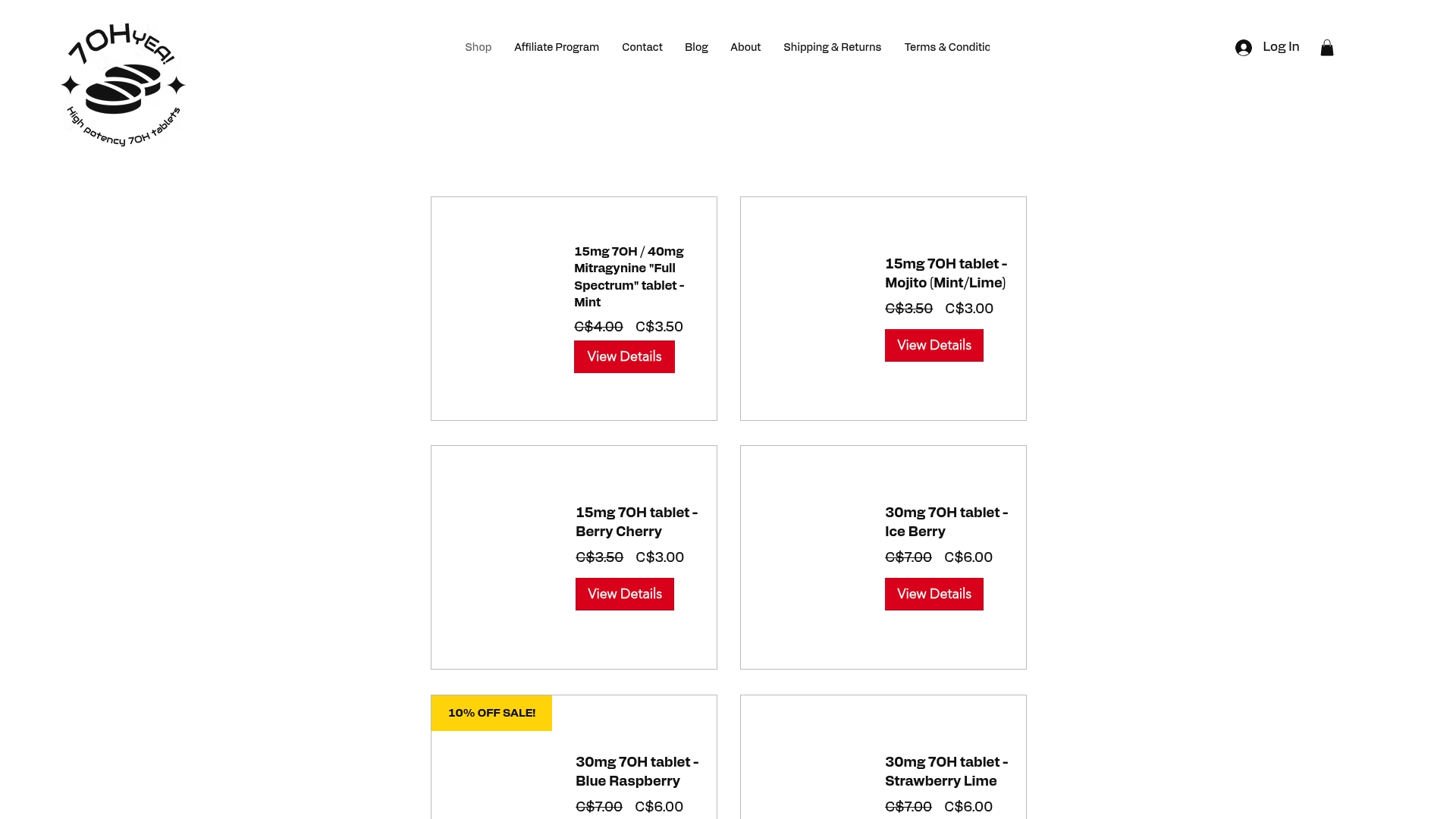
Visit 7ohyea.ca to review current SKUs, request batch documentation, or contact the team for institutional purchasing inquiries. All products are supplied for research use only and are not intended for human consumption.
Useful sources
“7-Hydroxymitragynine is an active metabolite of mitragynine and a key mediator of its analgesic effects.” — Kruegel et al., ACS Central Science, 2019, as cited in multiple pharmacology reviews.
Pharmacological Comparison of Mitragynine and 7-Hydroxymitragynine (PMC) — Primary source for Ki values, GTPγS Emax data, and antinociception comparisons.
Chemical Composition and Biological Effects of Kratom, Scientific Reports — G-protein bias data, CYP inhibition findings, and chemotype variability across commercial products.
Chemical Composition and Biological Effects of Kratom (PMC) — Abuse liability, tolerance, and dependence data; plant alkaloid quantification.
Mitragynine Metabolism and Pharmacology, Washington University — CYP3A metabolic pathway evidence and intersubject variability discussion.
Exploring Therapeutic Potential of Mitragynine and Corynoxeine (PMC) — Alkaloid composition data including 7-OH abundance (0.01–0.03% of total alkaloids).
Safety Profile and Neurocognitive Function After Single Doses of Mitragynine (PMC) — Human PK data, LC-MS/MS LLOQ values, and single-dose tolerability findings.
Multi-Therapeutic Potential Review of Mitragynine and 7-OH (ScienceDirect) — Comprehensive review of chemistry, extraction, pharmacology, and toxicity across 150 papers.
Chemistry of Alkaloids from Malaysian Mitragyna speciosa (PMC) — Ki values for 14 alkaloids, UPLC-MS quantification method, and chemotype evidence.
Recommended
Comments