
Forced Degradation Studies: A Practical Guide for Pharmaceutical Scientists
- 7OHyea
- Aug 4
- 17 min read


Forced degradation studies deliberately expose a drug substance or product to controlled extreme conditions to reveal degradation pathways and to demonstrate that your analytical methods are stability-indicating. The core regulatory expectation, codified in ICH Q1A(R2), is straightforward: stress testing must identify likely degradants, map the pathways by which they form, and confirm that your analytical procedure can resolve the parent compound from every significant impurity. Without that confirmation, no stability data you generate later carries regulatory weight.
Before you design a single experiment, your study must be positioned to deliver four minimum outputs:
Identified degradants with structural characterization or a documented rationale for why full ID was not pursued
Degradation pathways covering hydrolysis, oxidation, photolysis, and thermolysis at minimum
A validated stability-indicating method with peak-purity evidence demonstrating specificity
Science-based endpoint justification explaining why your chosen stress severity is appropriate, typically targeting 5–20% degradation rather than an arbitrary fixed condition
ICH Q2(R1) governs the method validation elements you need to prove specificity, and FDA’s photostability guidance under ICH Q1B sets the exposure parameters for light stress. Together, these three documents form the regulatory backbone of every defensible forced degradation protocol in the U.S.
Table of Contents
What do regulators actually expect from your forced degradation data?
How do you choose the right stress conditions for your molecule?
How do you prepare samples and prove your method is stability-indicating?
How should you document forced degradation results for regulatory submissions?
How does forced degradation feed into QbD and formulation strategy?
A practitioner’s perspective on tradeoffs and pragmatic decisions
When should you run forced degradation studies?
Timing matters more than most development teams acknowledge. Running stress testing too late means your analytical method is already locked before you know whether it can resolve the degradants your molecule actually generates. Running it too early, before you have a representative synthesis route or formulation, means you may repeat the work entirely.
The practical answer is to run stress testing at three points in development:
Pre-formulation and method development: Use stress data to map molecular vulnerabilities before selecting excipients or packaging. This is where you identify which functional groups are labile and which stress pathways dominate.
Prior to the pivotal stability protocol: Confirm that your stability-indicating method resolves all stress-generated degradants before you commit to a long-term ICH stability study. A method that fails peak-purity checks at this stage forces revalidation under time pressure.
Before a regulatory filing: Ensure your forced degradation report is complete, with structural IDs or documented rationale, so it can serve as an appendix to your CMC or stability section without triggering a deficiency letter.
ICH Q1A(R2) specifies that stress testing is typically performed on a single batch of drug substance. For drug product, you apply relevant stresses (solution-phase, solid-state, photolytic) to understand how the formulation matrix affects degradation behavior, particularly when excipients can catalyze or inhibit specific pathways.
The study objectives map directly to downstream decisions. Stress data informs excipient compatibility screening, container-closure selection, and the impurity profile that feeds your ICH Q3A/Q3B threshold assessments. Reviews of forced degradation methodology consistently identify packaging selection and formulation optimization as two of the most practically valuable outputs, alongside the analytical method validation deliverable. If your team treats stress testing as a regulatory checkbox rather than a design tool, you will almost certainly encounter avoidable revalidation or packaging failures later.
What do regulators actually expect from your forced degradation data?
The regulatory framework for stress testing in the U.S. rests on three ICH guidelines that work in sequence. ICH Q1A(R2) defines the requirement and scope. ICH Q1B specifies photostability conditions. ICH Q2(R1) governs the method validation that proves your analytical procedure is stability-indicating. Understanding how they interlock prevents the most common submission deficiencies.
ICH Q1A(R2) states: “Stress testing helps to determine the intrinsic stability of the molecule by establishing degradation pathways in order to identify the likely degradation products and to validate the stability-indicating power of the analytical procedures used.”
U.S. FDA reviewers, particularly in ANDA and NDA reviews, look for four things that many submissions still fail to provide clearly:
Technical justification for stress severity: Why did you choose 0.1 N HCl at 60°C for 24 hours? The rationale must be documented, not implied.
Peak-purity evidence: PDA spectral purity data or MS confirmation that the main peak is homogeneous under stress conditions. Missing this is the single most cited deficiency in forced degradation submissions.
Quench procedure documentation: How did you stop the reaction? Undefined quench methods raise questions about whether degradation continued post-treatment.
Handling of non-degrading conditions: If a stress condition produced no degradation, you need a documented scientific rationale, not a blank result.
A PharmTech analysis of FDA perspectives on forced degradation in ANDA submissions confirms that incomplete scientific rationale and absent peak-purity data are the two most frequent triggers for deficiency letters in this area. Reviewers also flag submissions where the forced degradation report is disconnected from the stability protocol, making it impossible to verify that the validated method was actually used in the long-term study.
The practical submission checklist for your forced degradation report:
Signed protocol with stress conditions, reagent concentrations, temperatures, and exposure times
Raw chromatograms for each stress condition and time point, including controls and blanks
Peak-purity data (PDA spectra overlay, purity angle vs. purity threshold, or MS peak tracking)
Method validation summary tied to ICH Q2(R1) specificity requirements
Structural IDs or a documented rationale for any unidentified degradant above the reporting threshold
Quench procedure with validation evidence that the reaction was stopped reproducibly
Scientific justification for endpoint selection and any non-degrading conditions
PMDA guidance aligns with ICH on all of these components and additionally specifies temperature increments and humidity conditions in detail, which is useful when designing studies intended for international submissions.
How do you choose the right stress conditions for your molecule?

Condition selection is where science-based decision-making separates defensible studies from arbitrary ones. The starting point is always the molecule itself: map the functional groups present and identify which are susceptible to hydrolysis, oxidation, photolysis, or thermal degradation before you run a single experiment.
Molecular vulnerability mapping
For a small molecule, scan the structure for ester, amide, and lactam bonds (hydrolytic risk), tertiary amines and sulfides (oxidative risk), aromatic chromophores and enones (photolytic risk), and any thermally labile configurations. For alkaloids like 7-hydroxymitragynine, oxidation-prone indole and tertiary amine moieties make oxidative and photolytic stress conditions particularly informative. This structural assessment, documented in your protocol, is the scientific rationale regulators expect to see.
The default stress battery
The standard battery covers five condition types, applied to both solution and solid-state samples where relevant:
Acid hydrolysis: typically 0.1–1.0 N HCl, 25–60°C, 1–24 hours
Base hydrolysis: typically 0.1–1.0 N NaOH, 25–60°C, 1–24 hours
Oxidative stress: 0.3–3% hydrogen peroxide, ambient temperature, 1–24 hours; or oxygen purge for sensitive molecules
Thermal stress: 50–80°C dry heat for solid-state; 60–70°C in solution
Photolytic stress: ICH Q1B Option II conditions, approximately 1.2 million lux hours and at least 200 watt·hours/m² near-UV
Humidity stress (75% RH at 40°C) applies primarily to solid-state drug product and is especially relevant for hygroscopic compounds or formulations containing moisture-sensitive excipients.
Endpoint strategy and severity escalation
Industry benchmarking and peer-reviewed analysis recommend targeting 5–20% degradation as the practical endpoint range. Below 5%, you have insufficient degradant signal to validate method specificity. Above 20%, secondary degradation products begin to appear, complicating pathway interpretation and potentially generating artifacts that would never occur under real storage conditions.
If your initial conditions produce less than 5% degradation, escalate stepwise: increase concentration, temperature, or exposure time, and document each attempt. If conditions exceed 20%, reduce severity before finalizing the protocol. Industry benchmarking and peer-reviewed analysis recommend targeting 5–20% degradation as the practical endpoint range. Below 5%, you have insufficient degradant signal to validate method specificity. Above 20%, secondary degradation products begin to appear, complicating pathway interpretation and potentially generating artifacts that would never occur under real storage conditions.
If your initial conditions produce less than 5% degradation, escalate stepwise: increase concentration, temperature, or exposure time, and document each attempt. If conditions exceed 20%, reduce severity before finalizing the protocol.
Historical work by Alsante, Baertschi, and Singh and Bakshi, reviewed in ScienceDirect’s endpoint analysis, shows that past approaches varied widely in severity, which is precisely why modern guidance emphasizes stepwise escalation over fixed single conditions.
What do practical forced degradation protocols look like?
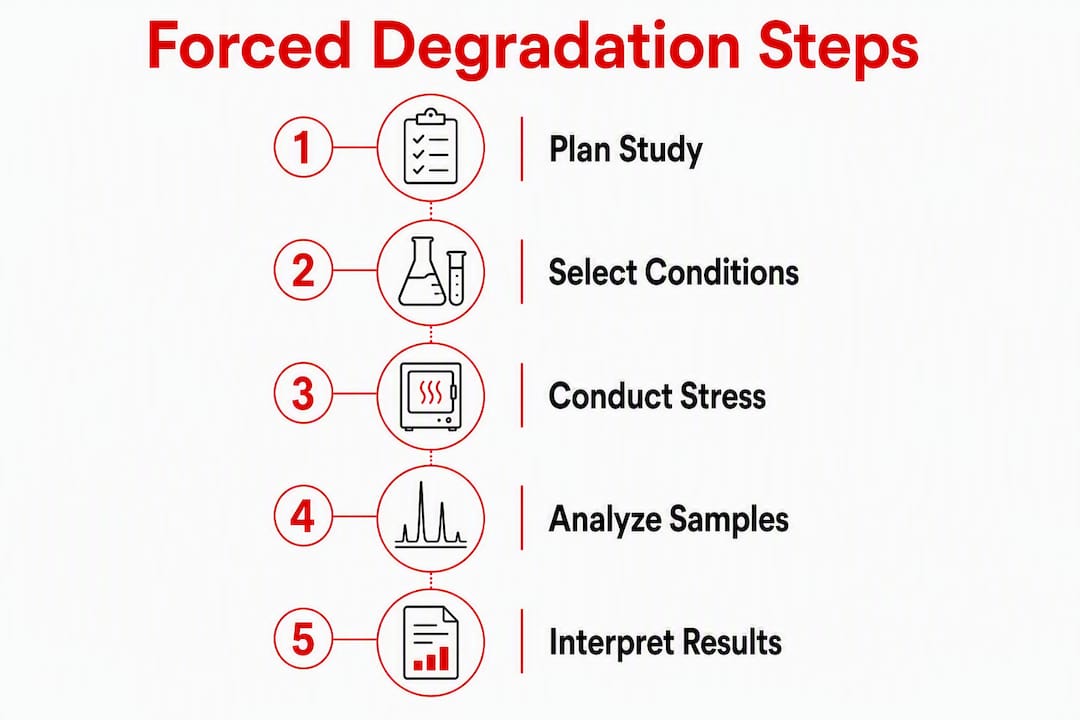
The table below summarizes parameter ranges for the five standard stress conditions. These are starting points; your molecular vulnerability assessment and endpoint targets will determine where within these ranges you begin and how you escalate.
Stress Condition | Reagent / Environment | Temperature | Exposure Time | Endpoint Guidance |
Acid hydrolysis | 0.1–1.0 N HCl (solution) | 25–60°C | 1–24 hours | Target 5–20% degradation; escalate concentration or time if <5% |
Base hydrolysis | 0.1–1.0 N NaOH (solution) | 25–60°C | 1–24 hours | Target 5–20% degradation; neutralize to pH 7 before injection and escalate if <5% |
Oxidative stress | 0.3–3% H₂O₂ (solution) | Ambient (25°C) | 1–24 hours | Quench with catalase; consider O₂ purge for sensitive molecules |
Thermal (solid-state) | Dry heat, open dish | 50–80°C | 1–4 weeks | Compare to protected control; monitor moisture uptake |
Photolytic | ICH Q1B Option II | Ambient | ~1.2 million lux·h / ≥200 Wh/m² UV | Use calibrated chamber; run foil-wrapped control in parallel |
Humidity (solid-state) | 75% RH / 40°C | 40°C | 1–4 weeks | Relevant for hygroscopic DS and moisture-sensitive DP |
Solution-phase versus solid-state considerations
Solution-phase stress accelerates hydrolytic and oxidative pathways efficiently and is the primary mode for drug substance characterization. Solid-state stress is indispensable for drug product because it mimics the physical environment of the final dosage form. A tablet matrix introduces excipient interactions that solution studies cannot capture: magnesium stearate can catalyze ester hydrolysis, and certain fillers can generate peroxide in situ, creating an oxidative microenvironment even without added reagent.
For drug substance, prepare solutions at a concentration that gives a detector response well above the limit of quantitation for degradants at the 0.05–0.1% level. A typical working concentration of 0.1–1.0 mg/mL in the stress reagent works for most small molecules by HPLC with UV detection. For drug product, extract the tablet or powder into the appropriate solvent, run a placebo extraction in parallel, and subtract excipient peaks before assessing degradant profiles.
Photostability protocol specifics
ICH Q1B offers two options for photostability exposure. Option II, the most commonly used in U.S. submissions, requires a minimum of approximately 1.2 million lux hours of visible light and at least 200 watt·hours/m² of near-UV energy. Use a calibrated photostability chamber with continuous monitoring; do not rely on calculated exposure times from nominal lamp output, as lamp aging reduces actual dose delivered. Run a chemical actinometer (quinine sulfate is the standard reference) alongside samples to confirm delivered dose.
Solid-state photostability samples should be spread in a thin layer (≤3 mm depth) to ensure uniform exposure. For solution samples, use clear glass vials and confirm that the solvent does not absorb significantly in the UV range, which would shield the drug from near-UV exposure.
How do you prepare samples and prove your method is stability-indicating?

Sample preparation quality determines whether your forced degradation data is analytically meaningful or just chromatographically busy. Two principles govern this stage: use high-purity reference material, and design your sample set to include every control needed for peak-purity assessment.
FDA reviewer guidance is explicit that low-purity starting material confounds peak-purity assessments and can generate misleading impurity profiles during method validation. For alkaloid reference materials, this means sourcing certified reference standards with documented purity and a Certificate of Analysis. 7ohyea’s research-grade 7-hydroxymitragynine materials are manufactured in British Columbia with rigorous quality assurance and are designed precisely for this kind of analytical work, where purity certainty is non-negotiable.
Chromatographic method requirements
Your primary analytical platform should be HPLC or UPLC with a photodiode array (PDA) detector. PDA detection is not optional for forced degradation work: it provides the spectral data needed to assess peak purity and to confirm that the main peak is homogeneous across the elution profile. A UV single-wavelength detector cannot provide this evidence.
For degradant identification and confirmation, orthogonal techniques are required:
LC–MS or LC–MS/MS: provides molecular weight and fragmentation data for structural hypothesis generation; essential for degradants above the identification threshold
High-resolution mass spectrometry (HRMS): gives accurate mass data to within a few ppm, enabling molecular formula assignment
NMR: required for confirmed structural ID of novel degradants; typically applied after LC–MS narrows the structural candidates
Column chemistry selection should prioritize resolution of the parent compound from all stress-generated peaks. A C18 column with a gradient from aqueous buffer to organic solvent covers most small molecules, but consider C8 or phenyl-hexyl phases if the parent and primary degradants have similar polarity. Run the gradient long enough to elute all peaks, including late-eluting oxidative degradants, which are frequently missed when gradients are truncated.
Proving stability-indicating power
The method validation elements required by ICH Q2(R1) for a stability-indicating method center on specificity. You must demonstrate:
Resolution: the method separates the parent peak from all degradants generated under each stress condition, with resolution ≥ 2.0 between adjacent peaks
Peak purity: PDA purity angle is less than the purity threshold across the entire main peak for each stressed sample
Linearity and range: covers the expected degradant concentration range, typically 0.05–0.2% of the nominal drug concentration
Accuracy and precision: validated at the reporting threshold level
Pro Tip: Run your peak-purity assessment on the most heavily degraded sample in your set, not the mildest. If the purity angle remains below the threshold even when 15–20% of the drug has degraded, you have strong evidence that co-eluting degradants are not present at analytically significant levels. Reviewers find this approach more convincing than purity data from lightly stressed samples.
For chromatographic and spectrometric detection methods applied to alkaloid compounds, the same principles apply: PDA confirmation of peak homogeneity, MS-based degradant tracking, and documented resolution criteria are the foundation of a defensible method validation package.
Method robustness should be assessed before the method is transferred to QC or used in pivotal stability studies. Vary column temperature (±5°C), pH (±0.2 units), and organic modifier percentage (±2%) to confirm that resolution and peak purity are maintained within the validated operating range.
How do you interpret results and map degradation pathways?
A chromatogram from a stressed sample is a hypothesis generator, not a final answer. The workflow from raw data to documented degradation pathway follows a consistent logic, regardless of molecule class.
Identify all new peaks in stressed samples relative to the unstressed control. Note retention time, UV spectrum, and relative area for each.
Assign preliminary pathway hypotheses based on stress condition and known chemistry. Peaks appearing only under acid/base conditions suggest hydrolytic products; peaks under oxidative conditions suggest N-oxides, sulfoxides, or hydroxylated species; photolytic peaks may indicate ring-opening or isomerization products.
Confirm molecular weight by LC–MS. A mass increase of +16 Da suggests hydroxylation or N-oxidation; a mass decrease consistent with loss of a known leaving group confirms hydrolysis. Fragmentation patterns narrow the structural assignment.
Prioritize degradants for full structural ID using the following criteria: any degradant above the ICH Q3A identification threshold (0.10% for a maximum daily dose ≤2 g), any peak that co-elutes with or is adjacent to the parent peak (analytical interference risk), and any degradant with a structural alert for genotoxicity.
Assess mass balance. Sum the areas of the parent peak and all degradant peaks and compare to the unstressed control. Mass balance within ±2% of the theoretical value confirms that all degradants are being detected. Poor mass balance (>5% deficit) indicates volatile degradants, insoluble precipitates, or detector-invisible species requiring investigation.
Escalate to HRMS or NMR for degradants that cannot be structurally assigned from unit-resolution MS data alone, particularly when the degradant is above the identification threshold or has a structural alert.
Document tentative versus confirmed IDs clearly in the report. A tentative ID supported by LC–MS data and chemical logic is acceptable for most regulatory purposes; a confirmed ID requires NMR or unambiguous HRMS data.
ICH Q1A(R2) explicitly accepts that some stress-generated degradants may not appear in long-term storage studies, and that documenting why certain degradants are not specifically targeted in the stability protocol is acceptable when scientifically justified. This is an important regulatory accommodation: you do not need to chase every stress artifact to confirmed ID, but you do need to explain your prioritization logic.
For alkaloid compounds with complex ring systems, such as the indole-based structures related to mitragynine and 7-hydroxymitragynine, degradation pathway analysis benefits from cross-referencing known oxidative and photolytic pathways for structurally related indole alkaloids in the literature before committing to a structural hypothesis.
How should you document forced degradation results for regulatory submissions?
Documentation is where technically sound science either survives or fails regulatory review. The report structure matters as much as the data quality, because reviewers assess both the scientific rigor and the clarity of your rationale.
Your forced degradation report should function as a standalone appendix to the stability or CMC section of your submission. Organize it in this sequence:
Protocol summary: stress conditions, reagent grades, concentrations, temperatures, exposure times, and quench procedures, with a clear statement of the endpoint target and the scientific rationale for each condition
Sample set description: drug substance batch number and purity, drug product lot, placebo composition, and all controls and blanks used
Raw chromatograms: one per stress condition and time point, labeled with injection sequence and instrument parameters; include the unstressed control chromatogram for direct comparison
Peak-purity data: PDA spectral overlay for the main peak under each stress condition, with purity angle and threshold values tabulated
Degradant summary table: retention time, relative area, UV max, molecular weight (if available), and structural assignment or rationale for absence of ID
Mass balance table: parent area plus degradant areas versus unstressed control, with commentary on any deficit
Method validation summary: specificity data tied to ICH Q2(R1), including resolution values and peak-purity results for the most heavily stressed sample
Common deficiencies to preempt
The deficiencies that most frequently delay U.S. submissions in this area fall into four categories:
Insufficient technical justification: stating “0.1 N HCl, 60°C, 24 hours” without explaining why that severity was chosen. The fix is a one-paragraph rationale per condition referencing the molecular vulnerability assessment and the endpoint target.
Missing peak-purity evidence: submitting chromatograms without PDA spectral purity data. Every forced degradation submission needs purity angle data, not just UV traces.
Unclear quench procedures: describing the quench in one sentence without specifying reagent, volume, pH endpoint, and timing. Reviewers need to confirm the reaction was stopped reproducibly.
Non-degradation without justification: reporting “no degradation observed” for a stress condition without a molecular stability rationale or evidence of escalation attempts. Per SOP guidance, document each escalation step and include literature support for the molecule’s resistance to that stress type.
When a stress condition genuinely produces no degradation after rigorous escalation, present the result as a positive finding with a molecular rationale, not as a gap. Reviewers are more likely to accept “the compound showed no hydrolytic degradation under conditions up to 1.0 N HCl at 80°C for 48 hours, consistent with the absence of hydrolytically labile functional groups” than a blank table cell.
Proper labeling and documentation practices, including how to frame analytical-use designations in regulatory narratives, are covered in depth in the analytical use only labeling guidance relevant to research-grade materials.
How does forced degradation feed into QbD and formulation strategy?
Treating forced degradation as a proactive quality-by-design tool, rather than a late-stage regulatory requirement, is the single most consequential strategic decision a development team can make. FDA perspectives on QbD integration confirm that stress data used strategically reduces the risk of costly rework later in development.
The connection between stress data and QbD runs through critical quality attributes (CQAs). Each degradation pathway you identify in forced degradation becomes a candidate CQA: if oxidative degradation generates a toxic impurity above the qualification threshold, oxidative stability is a CQA, and your control strategy must address it. If photolytic degradation is significant, packaging opacity becomes a critical design parameter. These linkages, documented early, become the foundation of your design space.
Practical integration points:
Excipient compatibility screening: run forced degradation on drug substance/excipient binary mixtures under thermal and humidity conditions to identify catalytic or inhibitory interactions before formulation is locked
Packaging selection: use photolytic and humidity stress data to define the minimum barrier properties required for container-closure selection, with quantitative degradation data as the acceptance criterion
Control strategy development: link each identified degradation pathway to a process parameter or formulation variable that can be controlled, and document the linkage in the pharmaceutical development report
Stability protocol design: use the degradation pathways and rates observed in stress studies to select the most discriminating storage conditions and time points for the ICH stability protocol
Pro Tip: When documenting QbD linkages in your pharmaceutical development report, use a risk-ranking table that maps each degradation pathway to its associated CQA, the control element addressing it, and the forced degradation data supporting the risk level. This format directly answers the question reviewers ask when they read your control strategy: “How do you know this is controlled?”
Molecule-specific stress protocols are particularly important for complex molecules where a one-size-fits-all battery misses the dominant degradation pathway. For oxidation-prone alkaloids, for example, metal-catalyzed oxidation using trace iron or copper salts in the stress solution can reveal degradants that hydrogen peroxide alone does not generate, because the radical mechanism differs. Documenting this distinction in your protocol rationale demonstrates the kind of molecular-level thinking that reviewers find credible.
The Blessy et al. 2013 review remains a widely cited reference for the role of forced degradation in formulation and analytical method development, and citing it alongside ICH guidance in your submission literature section signals methodological rigor to reviewers.
Key Takeaways
Forced degradation studies are the foundation of every defensible stability-indicating method, and their value extends well beyond regulatory compliance into formulation design, packaging selection, and QbD risk ranking.
Point | Details |
Target degradation that generates sufficient degradant signal for method validation without producing secondary artifacts that complicate pathway interpretation. | |
Peak-purity evidence is non-negotiable | PDA spectral purity data for the main peak under each stress condition is the most frequently cited missing element in FDA deficiency letters. |
Document every quench procedure | Define reagent, volume, pH endpoint, and timing; unvalidated quench methods allow post-treatment degradation that corrupts analytical results. |
Map molecular vulnerabilities first | Structural assessment of labile functional groups before condition selection is the scientific rationale regulators expect to see in your protocol. |
Non-degradation needs a rationale | When a stress condition produces no degradation after escalation, document the molecular stability rationale and escalation attempts rather than reporting a blank result. |
A practitioner’s perspective on tradeoffs and pragmatic decisions
The most persistent tension in forced degradation work is between thoroughness and timeline. Development teams under pressure to advance a molecule often ask how much stress testing is “enough” before the pivotal stability study. The honest answer is that “enough” is defined by the regulatory submission, not by the number of conditions run.
What I find underappreciated in practice is the cost asymmetry between doing this work early and doing it late. A method that fails peak-purity checks during a pre-NDA review forces revalidation under the worst possible time pressure, with a fixed submission deadline and a QC lab already committed to the existing method. Running a thorough forced degradation study at the method development stage, even if it takes an extra four to six weeks, eliminates that risk almost entirely.
The over-stressing problem is equally real and less discussed. Teams that push conditions until they see “something happening” routinely generate degradants that are artifacts of extreme chemistry, not products of any realistic storage pathway. These artifacts then require structural ID work, consume resources, and occasionally trigger genotoxicity flags that delay the program. The 5–20% endpoint range exists precisely to prevent this, and the stepwise escalation approach, documented in the protocol, gives you a defensible record of why you stopped where you did.
On the question of when to escalate to orthogonal ID methods: the threshold should be regulatory, not analytical curiosity. If a degradant is above the ICH Q3A identification threshold, you need structural data. If it is below the threshold and shows no structural alert, a tentative LC–MS assignment with documented reasoning is defensible. Spending NMR instrument time on a 0.03% degradant with no genotoxic alert is a resource decision that rarely pays off in submission quality.
The practical recordkeeping point that gets teams into trouble most often is quench timing. Stress reactions that are quenched at different times on different days, even by the same analyst, produce different degradant profiles. Define the quench procedure in the protocol, train every analyst on it, and document the exact quench time in every sample preparation record. Reviewers who see inconsistent degradant profiles across replicates will ask about this, and “analyst variability” is not an acceptable answer.
Finally, when you write the regulatory narrative for your forced degradation section, present your scientific judgments as decisions, not as limitations. “Conditions were selected based on the molecular vulnerability assessment; hydrolytic stress was limited to pH 1–13 because no hydrolytically labile groups are present” reads as confident science. “We were unable to achieve significant degradation under hydrolytic conditions” reads as a gap. The data may be identical; the framing determines whether a reviewer asks a question.
Authoritative references and further reading
The references below are the primary sources you should cite when designing forced degradation studies and preparing regulatory submissions. They are organized by authority level and intended use.
Primary regulatory guidance (cite in submissions):
ICH Q1A(R2): Stability Testing of New Drug Substances and Products — the foundational requirement for stress testing scope, batch selection, and documentation expectations
ICH Q1B: Photostability Testing of New Drug Substances and Products (FDA) — defines Option I and Option II photostability conditions, including the 1.2 million lux·hour and 200 Wh/m² UV dose requirements
ICH Q2(R1): Validation of Analytical Procedures — governs specificity, linearity, and precision requirements for stability-indicating method validation
PMDA Stability Testing Guidance — useful for international submissions; aligns with ICH and provides detailed condition specifications including temperature increments and humidity parameters
Peer-reviewed methodology references (cite for methodological rationale):
Pharmaceutical forced degradation endpoints: a scientific rationale and industry perspective (ScienceDirect) — the most current peer-reviewed analysis of endpoint selection, stepwise escalation, and the 5–20% degradation range; cites Alsante, Baertschi, and Singh and Bakshi benchmarking work
Blessy et al.: Development of forced degradation and stability-indicating studies of drugs — a review (PMC) — widely cited 2013 review covering formulation development and analytical method applications
Review on forced degradation studies: principles, methodology, and analytical perspectives (IJPS) — covers impurity profiling, excipient compatibility, and packaging selection use cases
Practical SOPs and FDA perspectives:
SOP for forced degradation study (PharmaDevils) — practical stepwise adjustment guidance and documentation expectations for the 5–15% target range
FDA perspectives on forced degradation in ANDA submissions (PharmTech) — current FDA reviewer priorities, common deficiency themes, and QbD framing for stress testing
Recommended
Comments