
Canadian Research Chemical Suppliers: A Procurement Guide
- 7OHyea
- Aug 5
- 10 min read


Source research-grade chemicals from established Canadian suppliers that provide per-lot Certificates of Analysis (COAs) and independent third-party testing. That is the short answer. Before you place any order, confirm three things: the supplier issues lot-specific COAs verified by an accredited external laboratory, the product carries a clear “research use only” declaration, and domestic shipping is available to avoid Canada Border Services Agency (CBSA) customs complications.
Immediate procurement checklist:
Request a per-lot COA showing purity percentage, assay method (HPLC or LC-MS), and lot number
Confirm third-party lab verification — not just a supplier-generated document
Obtain the Safety Data Sheet (SDS/MSDS) and chain-of-custody record
Verify the supplier’s research-use-only policy and purchaser attestation requirement
Confirm accepted payment methods and domestic shipping options before checkout
Identify your chemical category (reference standard, reagent, peptide, or alkaloid)
Cross-reference the substance against the Controlled Drugs and Substances Act (CDSA) schedule
Contact the supplier and request documentation before committing to payment
Route the purchase through your institution’s internal approval process
Archive all supplier documents for audit readiness
Table of Contents
What does “research chemicals” actually cover for Canadian labs?
The term “research chemicals” is a broad commercial descriptor, not a recognized regulatory category under Canadian law. For procurement purposes, it typically spans four subcategories: certified reference standards used to calibrate analytical instruments, analytical reagents used in assay development, synthetic peptides produced for in vitro studies, and alkaloid reference materials used in pharmacological and toxicological research.
What the category does not include: therapeutic products regulated under the Food and Drugs Act, controlled substances listed under the CDSA, or any material marketed for human consumption. The distinction matters because it determines which regulatory pathway applies to your purchase and what documentation your institution must retain.
Subcategory | Typical Use | Key Documentation |
Reference standards | Instrument calibration, method validation | Per-lot COA, traceability certificate |
Analytical reagents | Assay development, sample preparation | SDS/MSDS, purity grade specification |
Synthetic peptides | In vitro receptor binding, cell studies | COA, HPLC purity data, MS identity confirmation |
Alkaloid reference materials | Pharmacological profiling, toxicology | Per-lot COA, third-party verification, declared intended use |
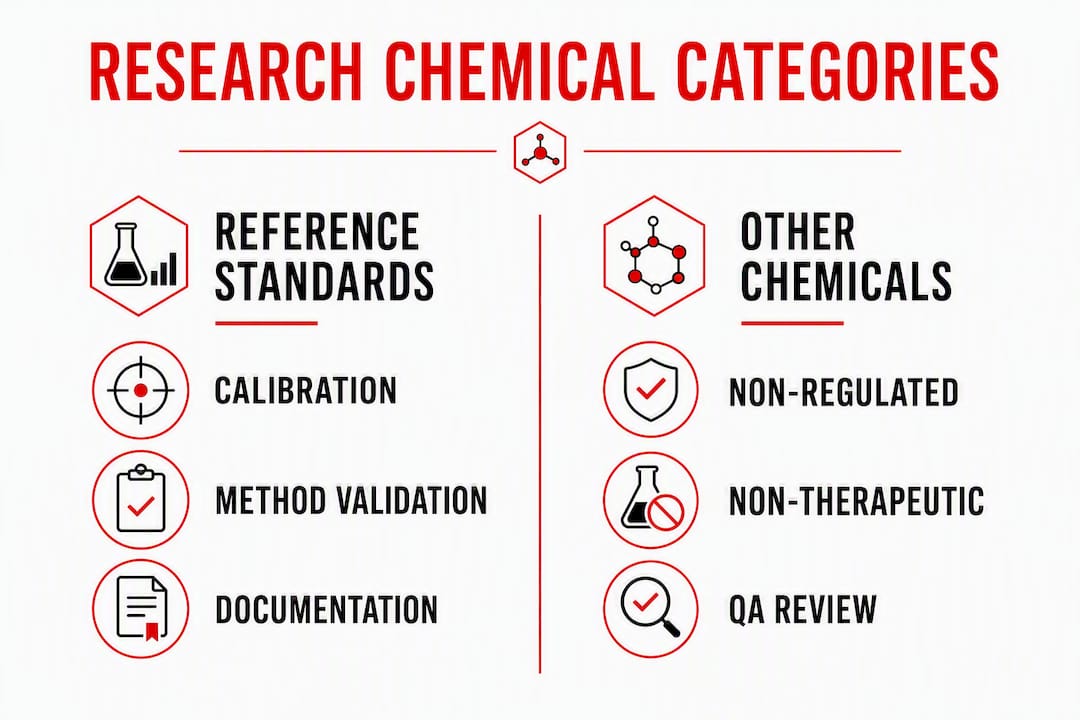
Labs that conflate these subcategories during procurement often end up with materials that fail internal QA review or, worse, trigger compliance questions during an institutional audit. Knowing which subcategory you are sourcing before contacting any vendor saves significant time and prevents documentation gaps.
What regulations govern research chemicals in Canada?
Three federal authorities shape every procurement decision for research chemical vendors in Canada.
Health Canada sets the regulatory framework for chemical substances, controlled drugs, and precursor chemicals. Its forward regulatory plan outlines upcoming rule changes that can affect which substances require licensing. Procurement teams at universities and contract research organizations (CROs) should monitor Health Canada’s chemical substances news for schedule amendments.
The Controlled Drugs and Substances Act (CDSA) is the primary statute. Any substance listed in its schedules requires a federal license or exemption to possess, produce, or distribute, even for research purposes. Buyers carry legal responsibility for confirming a substance’s CDSA status before ordering.
Canada Border Services Agency (CBSA) controls what crosses the border. Cross-border shipments of research chemicals are subject to CBSA inspection, and some categories require import permits issued through Health Canada before the shipment is released. Domestic suppliers eliminate this variable entirely.
Institutional responsibilities go beyond the purchase itself. Universities and CROs typically require a research-use declaration signed by the principal investigator, internal biosafety or chemical safety committee approval for certain compound classes, and documented retention of all supplier COAs and SDS records for a defined period (commonly five years).
Pro Tip: Before ordering any substance you have not previously purchased, run a CDSA schedule check and confirm with your institution’s compliance office whether an internal approval form is required. Doing this after the order arrives creates delays and potential compliance exposure.
Legal responsibility for compliant and lawful use rests with the purchaser and their institution, not the supplier. Suppliers commonly state they are not licensed drug manufacturers or distributors, and that declaration is legally meaningful: it places the compliance burden squarely on the buying organization.
What quality documents should you require from any supplier?
A per-lot COA is non-negotiable. It must state the lot number, purity percentage, the analytical method used (HPLC or LC-MS at minimum), the testing date, and the lab that performed the analysis. A COA that lists only a generic purity range without a lot number or named testing laboratory is not fit for institutional procurement.
Independent third-party verification is the single most important quality signal. Supplier-generated COAs differ fundamentally from COAs verified by independent third-party laboratories; an external lab such as Janoshik Analytical provides unbiased confirmation of purity and identity that a supplier cannot credibly provide for its own product. When a supplier claims ISO-accredited testing, ask for the accreditation certificate number and verify it against the accrediting body’s public registry.
Document | What to Check | Why It Matters |
Per-lot COA | Lot number, purity %, assay method, testing lab name | Confirms identity and purity for that specific batch |
Third-party lab report | Lab name, accreditation status, HPLC/MS data | Provides unbiased verification independent of supplier |
SDS/MSDS | GHS hazard classification, storage conditions, disposal | Required for lab safety compliance and waste management |
Chain-of-custody record | Batch origin, handling log, retention sample policy | Supports audit traceability and dispute resolution |
ISO/GMP claim documentation | Certificate number, issuing body, scope | Verifies manufacturing quality claims |
Confirm the supplier retains a reference sample from each lot for at least 12 months
Ask whether the COA is available before payment or only after shipment
Request storage and stability data, particularly for temperature-sensitive materials
For reference material certification, confirm the certification scope matches your intended analytical application
Pro Tip: When reviewing a COA, look for the specific HPLC column and gradient conditions used. A COA that lists “HPLC” without method details cannot be independently reproduced, which undermines its value for method validation work.
What can Canadian manufacturers and custom-synthesis providers deliver?
Domestic Canadian manufacturers typically offer analytical-grade synthesis, lyophilized peptide production, HPLC purity verification, and small-batch custom synthesis for novel reference compounds. Statistics Canada tracks domestic chemical and synthetic resin production, which gives procurement teams a baseline for understanding which chemical classes have established domestic production capacity.
Before committing to a custom synthesis run, confirm the following with any Canadian supplier:
GMP or ISO certification scope and the issuing body’s name
Available analytical methods (HPLC, LC-MS, NMR) and whether reports are included in the base price
Retention sample policy: how long, how much, and under what conditions
Confidentiality and IP handling for novel compound structures
Minimum order quantity for custom runs and whether scale-up pricing is available
Typical timelines for in-stock items from domestic suppliers run 1–5 business days for delivery once payment clears. Custom synthesis is a different timeline entirely: expect 2–6 weeks depending on compound complexity, with an additional 5–10 business days for independent third-party QC before dispatch. Domestic manufacturing eliminates CBSA import risk, which can add unpredictable delays of days to weeks for cross-border shipments.
For custom dosage planning, confirm with your supplier whether formulation adjustments (tablet vs. powder, dosage concentration) affect the synthesis timeline or the documentation package.
How do you find and verify Canadian research chemical suppliers?
Combining search engines, industry directories, and trade referrals is the most reliable sourcing approach. Directories can be stale, so direct verification and peer referrals from other lab managers carry more weight than any catalog listing. CAS SciFinder integrates supplier records and chemical availability data, making it a practical first stop for identifying vendors before procurement begins.
Vendor verification checklist:
Request a lot-specific COA before placing any order
Ask for the independent third-party lab report, including the lab’s name and accreditation number
Confirm the supplier enforces a research-use-only policy and requires purchaser attestation
Verify domestic shipping capability and confirm the carrier and transit time estimate
Check accepted payment methods — many processors restrict research chemical transactions, so suppliers often accept Interac e-Transfer or cryptocurrency
Ask for references from other institutional buyers if you are placing a first-time order above a threshold your institution sets
Red flags to watch for:
Refusal to provide lot-specific COAs or offering only a generic batch certificate
Inconsistent or unverifiable contact details (no physical address, no business registration)
No clear research-use-only policy or purchaser qualification requirement
Sole reliance on credit card payment when processors commonly disallow the category
No stated return or retesting policy for disputed shipments
Pro Tip: Search the supplier’s business name against provincial corporate registries and cross-reference their listed address. A supplier with no verifiable Canadian business registration warrants additional scrutiny before any payment is made.
For a broader comparison of domestic alternatives to large international vendors, institutional procurement teams often find that Canadian suppliers offer faster turnaround and simpler documentation chains.

What should you budget for lead times and shipping costs?
Order Milestone | Typical Timeframe |
Internal QC and COA review | Day 1–3 |
Dispatch from domestic fulfillment | Day 2–4 |
Delivery to Canadian lab | Day 3–7 |
Some domestic suppliers offer same-day dispatch for orders placed before a noon cutoff, with free shipping above a minimum order value. Domestic transit typically runs 1–5 business days, compared to cross-border shipments that can stall at CBSA for an indeterminate period.
Primary cost drivers to budget for:
Custom synthesis complexity: novel compounds cost more than catalog items
Independent third-party testing fees, which some suppliers pass through as a line item
Expedited shipping for time-sensitive protocols
Retention-sample archiving, which may carry a storage fee for long-term holds
Payment method constraints affect cash flow planning. Many mainstream payment processors and credit card companies prohibit transactions for research chemicals, so Canadian suppliers frequently rely on Interac e-Transfer or cryptocurrency. Budget for the settlement timing of these methods, particularly for first-time orders where the supplier may hold dispatch until payment fully clears.
How does 7ohyea support compliant research procurement?
7ohyea (operating as 7OH Canada) supplies research-grade 7-hydroxymitragynine (7OH) tablets and powders, sourced and manufactured in British Columbia, for analytical and laboratory use only. The product line covers 15mg, 30mg, and 50mg tablet formulations alongside powder options, with all materials labeled for research use and not intended for human consumption.
Quality and trust signals procurement teams can expect from 7ohyea:
Per-lot COAs available for every batch, with purity data and testing method specified
Third-party lab verification confirming identity and purity before dispatch
Domestic fulfillment from British Columbia, with typical delivery inside Canada within 3–7 business days
Clear research-use-only labeling on all products and packaging
Customizable dosage options to match specific protocol requirements
Documented return and retesting policy for disputed shipments
To order, researchers confirm their institutional affiliation and intended research application. Payment options and shipping details are confirmed at checkout. COA requests can be submitted before or alongside an order. The 30mg 7OH tablet and 15mg 7OH tablet are common starting points for labs establishing a new analytical protocol.
Pro Tip: When ordering from 7ohyea for the first time, request the COA and third-party lab report before finalizing your purchase requisition. Having both documents in hand before the order ships simplifies internal approval and audit documentation.
For a detailed breakdown of dosage options and QA practices, the 7OH tablets buying guide covers the full product range and documentation expectations.
Key Takeaways
Reliable procurement from Canadian research chemical suppliers depends on per-lot COA verification, independent third-party testing, CDSA compliance checks, and domestic sourcing to avoid CBSA import delays.
Point | Details |
COA is non-negotiable | Every batch must carry a lot-specific COA with named testing lab, assay method, and purity percentage. |
Independent testing over supplier COAs | Third-party lab verification by an accredited external lab provides unbiased purity and identity confirmation. |
CDSA check before ordering | Confirm a substance’s schedule status under the CDSA and obtain institutional approval before any purchase. |
Domestic suppliers reduce risk | Canadian fulfillment eliminates CBSA customs delays and simplifies chain-of-custody documentation. |
7ohyea for 7OH alkaloid research | 7ohyea supplies per-lot COA-verified, third-party tested 7-hydroxymitragynine tablets and powders from British Columbia for lab use. |
What procurement practice most labs get wrong
The most consistent failure mode in research chemical procurement is not choosing the wrong supplier. It is skipping the documentation review until after the order arrives. Lab managers routinely approve a purchase based on a supplier’s catalog description, then discover the COA is supplier-generated with no external verification, or the SDS is a generic template that does not match the specific lot. By that point, the material is in the building, the payment has cleared, and the institutional compliance review is already behind schedule.
Independent third-party verification is not a premium add-on. For any material entering a regulated research environment, it is the baseline. A supplier that cannot name the external laboratory that verified their product, or that cannot produce a lot-specific report on request, is not a supplier worth the compliance exposure.
The second failure mode is underestimating payment friction. Procurement officers accustomed to standard purchase orders sometimes assume credit card payment will work. For research chemical vendors in Canada, it frequently does not. Planning for Interac e-Transfer or cryptocurrency from the start, and routing that through your institution’s finance team early, prevents a last-minute scramble that delays the entire project timeline.
The practical lesson: treat the documentation review as part of the procurement process, not a post-delivery formality. Request COAs, third-party reports, and SDS records before the purchase order is signed. Archive everything. When a new supplier is involved, build an extra week into the project schedule for independent verification.
7ohyea delivers verified 7OH materials for Canadian labs
For labs sourcing 7-hydroxymitragynine reference materials, 7ohyea offers a direct domestic alternative to navigating international suppliers and CBSA import uncertainty. Every order ships from British Columbia with a per-lot COA and third-party lab verification included, so your documentation package is complete before the material reaches your bench.
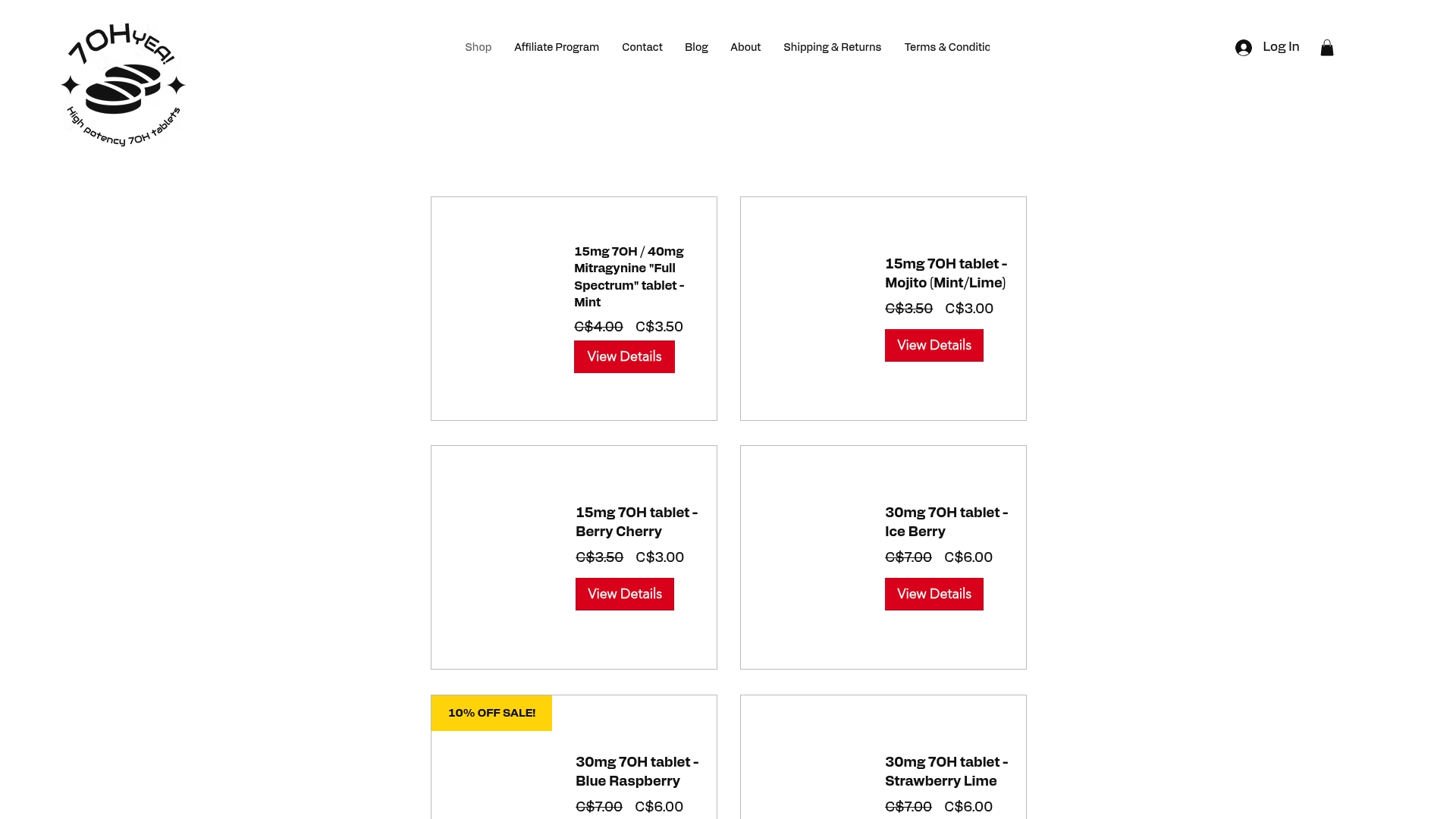
Dosage options at 15mg, 30mg, and 50mg give research teams the flexibility to match formulation to protocol without custom synthesis lead times. The research-use-only labeling and purchaser attestation process align with institutional compliance requirements from the first order. Payment via Interac e-Transfer keeps transactions straightforward, and domestic fulfillment means delivery in days rather than weeks.
Browse the full product range at 7ohyea.ca and request your lot-specific COA and third-party lab report at checkout. If your procurement office needs documentation before approving the purchase order, contact 7ohyea directly to receive the COA package in advance.
Authoritative sources and references for procurement teams
Procurement teams should consult and archive the following resources alongside supplier documentation:
Health Canada Forward Regulatory Plan — monitor for schedule amendments affecting your compound categories
Health Canada Chemical Substances News — current regulatory updates relevant to research chemical procurement
CDSA Regulations (SOR-2005-247) — primary statutory reference for controlled substance schedule verification
CAS SciFinder Chemical Vendor Directory — supplier discovery and chemical availability mapping
Statistics Canada: Chemicals and Synthetic Resins Production — domestic production data for sourcing feasibility assessment
For internal reference material traceability guidance, the reference material traceability guide and analytical-use-only labeling compliance resource are practical additions to any procurement record set.
This article provides general informational guidance on research chemical procurement in Canada and does not constitute legal or regulatory advice. Confirm current CDSA schedules, import requirements, and institutional obligations with Health Canada, your institution’s compliance office, or a qualified regulatory professional before placing any order.
Recommended
Comments