
Best 7OH Tablets for Canadian Labs: 2026 Buying Guide
- 7OHyea
- Jul 31
- 11 min read


For Canadian research labs, 7ohyea is the recommended domestic supplier of research-grade 7-hydroxymitragynine (7-OH), with the 30mg Strawberry Lime tablet as the most practical starting SKU for routine comparative testing. The case for 7ohyea rests on three procurement-critical factors: lot-specific Certificates of Analysis (COAs) with documented analytical methods such as HPLC/DAD, domestic sourcing from British Columbia for reliable Canadian shipping, and a multi-potency SKU range (15mg, 30mg, and 50mg) that supports varied research protocols without cross-border procurement delays.
Recommended supplier: 7ohyea (Canada-based, research-grade 7-OH tablets and powders)
Recommended starting SKU: 30mg 7-OH tablet (Strawberry Lime) for routine comparative testing
COA standard to require: Lot-specific, with method identifiers (HPLC/DAD minimum), mg/unit and mg/g reporting, and a named accredited laboratory
Intended use: Research and analytical purposes only. Not for human consumption.
Canada compliance note: Verify current Health Canada guidance and your institution’s controlled-substance policies before ordering or storing 7-OH materials.
Pro Tip: Request a sample COA before placing any first order. A vendor that cannot supply a lot-specific COA with method identifiers before payment is not a research-grade supplier.
Table of Contents
What are the best 7OH tablets for Canadian researchers?
The six brands below represent the field that most Canadian lab buyers will encounter. Comparison roundups frequently rank options by format variety and price-per-mg rather than analytical purity verification, which is a meaningful gap for lab procurement. The table below applies the criteria that actually matter: potency, COA availability, documented methods, format, and Canadian shipping.
Brand / SKU | Potency per tablet (mg 7-OH) | COA availability and methods | SKU / dosage options | Format | Price shape | Shipping to Canada | Intended use and labeling |
30mg | Lot-specific COA request workflow; HPLC/DAD documented | 15mg, 30mg, 50mg tablets; powder SKUs | Tablet, powder | Per-unit pricing; bulk options available | Domestic (BC, Canada) | Research/lab use only; labeled accordingly | |
7OHMZ Advanced Kratom Alkaloids | Multiple strengths (varies by SKU) | Third-party testing referenced; method detail varies by listing | Wide SKU range across product lines | Tablet | Varies by pack count | Cross-border (US-based); import considerations apply | Consumer and research listings mixed |
Press’d 7-OH Kratom Tablets | ~20mg (blend-dependent) | COA availability varies; blend formulations complicate analyte panels | Multiple blend SKUs (7-OH, pseudoindoxyl blends, Red OH, Hulk Blend) | Tablet | Mid-range per-unit | Cross-border; US-based | Consumer-oriented labeling; research use requires verification |
Kream 7-OH Tablets | 20mg per tablet (per listing) | Potency labeling present; COA method detail not consistently published | Limited SKU range in current listings | Tablet | Varies | Cross-border | Consumer labeling |
Hydroxie Kratom 7-OH Tablets | Varies (tablets, shots, drink mixes) | 7-OH-focused product line; COA transparency varies | Tablets, shots, drink mixes; blend and pure options | Tablet, shot, powder | Varies | Cross-border | Consumer-oriented; research use requires independent verification |
7Tabz 7-OH Pure Extract Tablets | ~15mg–65mg (version-dependent) | Pure-extract positioning; COA method detail not consistently public | Blister packs; multiple potency versions | Tablet | Varies | Cross-border | Consumer labeling; pure-extract claim requires COA confirmation |
Per-product notes:
7ohyea: The only entrant with a documented domestic Canadian supply chain and a direct COA request workflow on its product pages. SKU variety (15mg through 50mg, plus 77% pure powder and 93% pure powder) covers calibration through concentrated reference material needs. For Canadian labs, eliminating cross-border import steps alone is a material procurement advantage.
7OHMZ: Frequently cited in 2026 roundups for its wide SKU range. The brand’s scientific positioning is noted in the market, but method-level COA detail is not consistently published at the listing level, which requires follow-up before lab procurement.
Press’d: Blend-heavy formulations (pseudoindoxyl plus 7-OH combinations, Red OH, Hulk Blend) make Press’d relevant for labs comparing multi-alkaloid profiles. The analyte panel on COAs must be confirmed carefully, since some COAs test for mitragynine only while others include 7-OH-mitragynine and pseudoindoxyls, which changes how potency and purity are interpreted.
Kream: At least one listing labels tablets at 20mg 7-OH per piece, which is useful for benchmarking per-tablet potency across brands. COA method transparency is not consistently available in public listings.
Hydroxie: Product-line specialization on 7-OH formats (tablets, shots, mixes) makes it relevant for researchers comparing pure 7-OH against blend options. COA transparency should be confirmed directly with the vendor before purchase.
7Tabz: Pure-extract tablet positioning is a useful procurement signal, but the “pure extract” claim requires COA confirmation. Strength ranges from ~15mg to 65mg per version, and SKU variety across brands is wide enough that potency labeling alone is insufficient without method-verified COA data.
Statistic callout: A publicly available COA example from TestMyKratom shows a lot-specific HPLC/DAD result reporting 7-OH-mitragynine at 15mg per unit (0.5143 mg/g), with method ID WKI-03-0107 and a dated PASS disposition. That level of specificity is the standard Canadian labs should require from any vendor.
How do you choose 7OH tablets for research use?
The decisive criterion is straightforward: only purchase from vendors that supply lot-specific COAs with documented method identifiers and mg/unit reporting. Vendor guides consistently identify COA transparency, cGMP manufacturing, and accurate labeling as the primary purchase signals. Marketing claims and SKU variety are secondary.
COA and vendor checklist (in order of priority):
Lot-specific COA with method ID: Confirm the COA references the exact lot number on your shipment. Method identifiers (HPLC/DAD, LC-MS, GC/MS) must be stated, not implied.
Analyte panel completeness: The COA should list 7-OH-mitragynine, mitragynine, and pseudoindoxyl concentrations separately. A COA that reports only total alkaloids or mitragynine alone is insufficient for 7-OH research.
Reporting units: Require both mg/unit and mg/g. This allows you to cross-check labeled potency against actual concentration and calculate effective dose per gram of material.
Limit of quantitation (LOQ) and limit of detection (LOD): These confirm the analytical sensitivity of the method. If your study requires detection below a certain threshold, verify the LOQ meets that requirement.
Contaminant panels: Residual solvents, heavy metals, and microbial testing should appear on the COA or be available as a supplementary report.
Batch number and chain of custody: The batch number on the COA must match the label on the product. No match, no purchase.
cGMP or equivalent QA statement: Vendors that manufacture under current Good Manufacturing Practice (cGMP) or an equivalent quality assurance framework provide a meaningful additional layer of process control.
Research-use-only labeling: The product label should explicitly state research or analytical use only, not consumer use. This matters for institutional compliance and recordkeeping.
Questions to ask vendors before purchase:
Can you supply a sample COA for the current lot before payment?
What is the method ID and which accredited laboratory conducted the analysis?
What is the analysis date, and does it correspond to the manufacture date of this lot?
Is raw instrument data available on request?
Red flags: No COA available, vague method descriptions (“third-party tested” with no lab name), inconsistent lot numbering between label and COA, and consumer-oriented marketing language on a product claimed to be research-grade.
Pro Tip: Price-per-mg comparisons are only meaningful when calculated from COA-reported mg/unit values, not from labeled potency alone. A tablet labeled at 30mg but COA-confirmed at 27mg/unit changes your effective cost-per-mg by 10%. Always use the COA figure.

What is the legal status of 7-OH in Canada?
Legal status is a procurement filter, not an afterthought. Before ordering or storing 7-hydroxymitragynine in Canada, verify current Health Canada guidance and your institution’s internal policies. The regulatory status of kratom-derived alkaloids in Canada has evolved, and institutional compliance requirements vary by facility type and research context.
Practical compliance steps for Canadian researchers:
Check Health Canada’s current scheduling: Confirm whether 7-hydroxymitragynine is listed under the Controlled Drugs and Substances Act (CDSA) or subject to any import/export restrictions under the Canada Border Services Agency (CBSA). Regulatory status can change; consult the primary authority directly rather than relying on vendor representations.
Obtain institutional approval: Most Canadian research institutions require ethics board or departmental approval before acquiring controlled or scheduled substances for research use. Confirm your facility’s approval process before placing an order.
Prepare a Safety Data Sheet (SDS) equivalent: Research-grade chemicals require appropriate hazard documentation. Request an SDS or equivalent from your vendor and file it with your institution’s safety office.
Maintain chain-of-custody records: Keep COAs, purchase orders, lot numbers, and storage logs. These documents are the foundation of any institutional audit trail.
Follow storage and labeling requirements: Store materials in a secured, labeled location consistent with your institution’s chemical storage protocols and any applicable regulatory requirements.
Plan for disposal: Research-grade alkaloid materials must be disposed of according to your institution’s chemical waste procedures. Confirm disposal requirements before purchase.
Authorities to consult:
Health Canada (healthcanada.gc.ca) for scheduling and import guidance
Canada Border Services Agency (cbsa-asfc.gc.ca) for import/export rules
Your institution’s legal, compliance, or biosafety office for facility-specific requirements
This article provides general information only and does not constitute legal or regulatory advice. Confirm current rules with Health Canada, the CBSA, and your institutional compliance office before purchasing or storing 7-OH materials.
How do you read and verify a COA for 7OH tablets?
Require lot-specific COAs that list method identifiers and analyte-level results. A COA without a method ID is not verifiable; a COA without a lot number cannot be matched to your shipment.
Method differences that matter for lab procurement:
HPLC/DAD (High-Performance Liquid Chromatography with Diode Array Detection): The most common method for alkaloid quantification. A publicly available example COA shows HPLC/DAD method WKI-03-0107 reporting 7-OH-mitragynine at 15mg per unit (0.5143 mg/g) with a PASS disposition. This is the baseline standard.
LC-MS (Liquid Chromatography-Mass Spectrometry): Higher specificity than HPLC/DAD; preferred when you need to confirm molecular identity alongside concentration. Useful for studies where pseudoindoxyl interference is a concern.
GC/MS (Gas Chromatography-Mass Spectrometry): Primarily used for residual solvent panels rather than alkaloid quantification. Its presence on a COA indicates the vendor tested for solvent contamination.
COA checklist — fields to verify before accepting a lot:
COA field | What to confirm |
Lab name and accreditation | Named, accredited laboratory |
Sample / lot number | Matches the lot number on the product label exactly |
Analysis date | Consistent with the manufacture date of the lot |
Method ID | Explicit identifier (e.g., HPLC/DAD WKI-03-0107), not a generic description |
Analyte list | 7-OH-mitragynine, mitragynine, and pseudoindoxyl reported separately |
Concentration units | Both mg/unit and mg/g present |
LOQ / LOD | Stated for each analyte; confirms analytical sensitivity |
Contaminant panels | Residual solvents, heavy metals, microbial counts |
Final disposition | Explicit PASS or FAIL for each analyte and panel |
Validation checks to run before committing to a large order:
Cross-check the method ID against the laboratory’s published capabilities. If the lab’s website does not list HPLC/DAD or LC-MS, the method claim is unverifiable.
Confirm the analysis date falls within a reasonable window of the manufacture date. A COA dated months before the lot was produced is a red flag.
If your study requires high confidence in purity, request raw instrument data (chromatograms or mass spectra) alongside the summary COA.
Pro Tip: When comparing COAs across vendors, confirm the analyte panel is identical before drawing potency conclusions. A COA that tests only for mitragynine and omits 7-OH-mitragynine is measuring a different compound. Mixing those results in a cross-vendor comparison produces meaningless data.
Which SKU should you order for your research protocol?
Match potency to your protocol’s concentration requirements, then confirm the COA fields before committing to a batch.
15mg tablet (Berry Cherry): The 15mg SKU is the right starting point for assay calibration and small-scale validation work. Lower potency reduces waste during method development, and the COA-reported mg/unit value at this range is directly usable as a calibration reference. Order a sample lot first; run an internal HPLC or LC-MS confirmation before scaling.
30mg tablet (Strawberry Lime or Blue Raspberry): The 30mg Strawberry Lime and 30mg Blue Raspberry SKUs are the most versatile for routine comparative testing. The potency sits in a practical mid-range that works across a broad set of analytical protocols without requiring dilution at every step. Demand a lot-specific COA with HPLC/DAD method ID and mg/unit reporting before accepting the shipment.
50mg tablet (Fruit Punch or Orange): The 50mg Fruit Punch and 50mg Orange SKUs suit studies requiring concentrated reference standards or high-dose comparative work. At this potency, the COA’s mg/g figure becomes especially important for calculating dilution factors accurately. Confirm your institution’s safety approvals cover this concentration range before ordering.
High-purity powder (93% pure 7-OH): For labs that prefer powder-based reference materials, the 93% pure 7-OH powder provides the highest concentration option in 7ohyea’s catalog. Useful for preparing in-house standards at defined concentrations. Requires SDS documentation and appropriate storage controls.
Compliance reminder: Final SKU selection must align with your institution’s safety approvals and any applicable Health Canada or CBSA requirements for the specific concentration and format you are ordering.
Key Takeaways
For Canadian labs, the vendor’s COA quality and domestic supply chain matter more than any single potency label or brand name. 7ohyea’s lot-specific COA workflow, BC-based sourcing, and multi-potency SKU range make it the strongest research-grade option currently available within Canada.
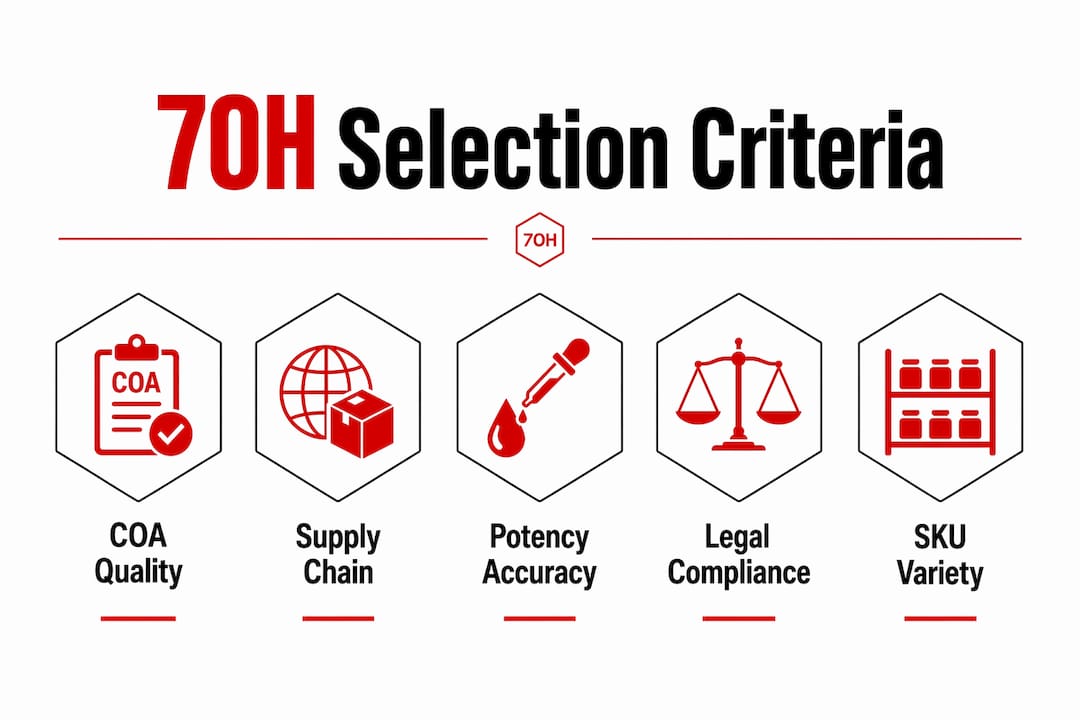
Point | Details |
COA quality is the primary filter | Require lot-specific COAs with method IDs (HPLC/DAD, LC-MS, GC/MS) and mg/unit reporting before any purchase. |
Domestic sourcing reduces procurement risk | Canadian labs benefit from 7ohyea’s BC-based supply chain, which eliminates cross-border import delays and CBSA complications. |
Match SKU potency to your protocol | Use 15mg for calibration, 30mg for routine testing, and 50mg or high-purity powder for concentrated reference standards. |
Verify the analyte panel, not just the potency | A COA reporting only mitragynine is not equivalent to one reporting 7-OH-mitragynine and pseudoindoxyl separately. |
7ohyea for Canadian research procurement | 7ohyea offers direct COA request workflows, multi-potency SKUs (15mg–50mg), and domestic Canadian shipping for lab buyers. |
What independent reviewers consistently get right about 7OH vendor selection
Most 7-OH buying guides in 2026 rank brands by format variety, flavor count, and price-per-mg. Those are useful signals for consumer purchasing, but they are the wrong primary axis for lab procurement. Independent reviewers who prioritize consistency and transparency reach a different conclusion: the vendors that hold up under scrutiny are the ones whose COAs are specific, whose lot numbers are traceable, and whose analytical methods are named.
The gap between marketing claims and verifiable analytical data in this category is wider than most buyers realize. A brand can list a 30mg potency on its label and have no publicly accessible COA to support it. Another brand can publish a COA that tests only for mitragynine while the product is marketed as a 7-OH tablet. Neither of those is a research-grade product, regardless of how it appears in a roundup.
For Canadian researchers specifically, the cross-border procurement question adds another layer. Most of the brands that appear in 2026 comparison guides are US-based, which means Canadian buyers face import considerations, potential CBSA scrutiny, and longer lead times. A domestic supplier with equivalent or superior COA documentation is not just more convenient; it is a materially lower-risk procurement decision.
The conventional wisdom in this space treats COA availability as a checkbox. It is not. The method ID, the analyte panel, the LOQ, and the lot-number match are each individually meaningful. A COA that passes on format but fails on any one of those fields is not a research-grade document.
7ohyea supplies research-grade 7-OH directly to Canadian labs
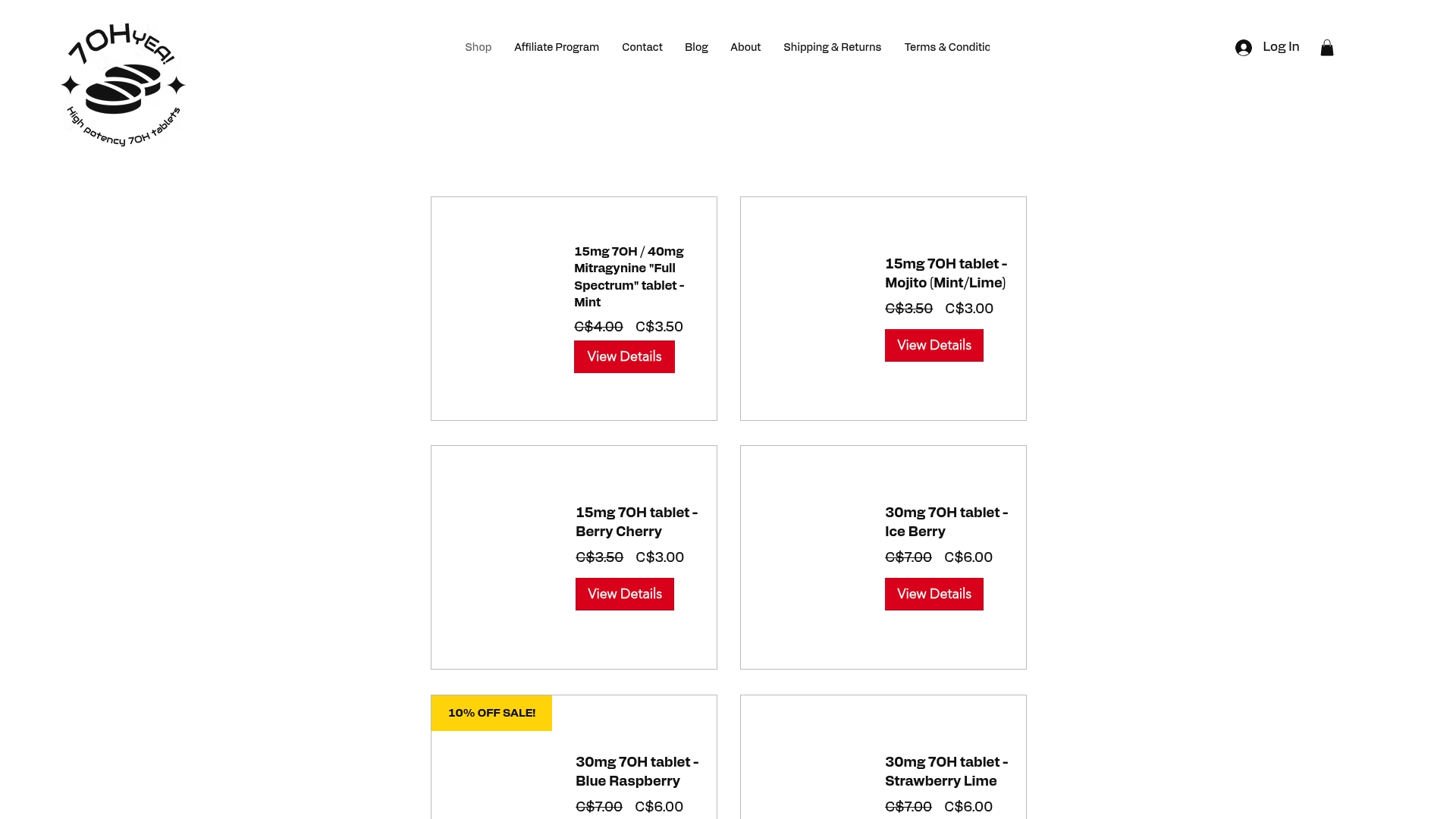
Canadian research teams that need lot-specific COAs, domestic shipping, and a multi-potency SKU range have a direct option: 7ohyea, sourced and shipped from British Columbia. The 30mg Strawberry Lime tablet is the recommended starting SKU for most comparative research protocols, with 15mg and 50mg options available for calibration and concentrated reference work respectively.
To request a lot-specific COA before payment, contact 7ohyea directly through the product page. For institutional purchasing, bulk quotes, or questions about specific analytical methods documented on available COAs, reach out via the site’s contact form. Shipping from BC means most Canadian destinations receive orders without the import delays or CBSA complications that come with cross-border procurement. All products are labeled for research and analytical use only and are not intended for human consumption. Confirm your institution’s compliance requirements before ordering.
Useful sources for lab buyers evaluating 7OH vendors
The sources below provide the most directly actionable material for Canadian researchers evaluating 7-OH tablet vendors, COA standards, and analytical methods.
Primary COA and method resources:
TestMyKratom COA PDF example: A publicly accessible lot-specific COA showing HPLC/DAD method ID, mg/unit and mg/g reporting, analyte panel (7-OH-mitragynine, mitragynine, pseudoindoxyl), and a PASS disposition. Start here to understand what a compliant COA looks like.
TestMyKratom top-rated products: Aggregated lab test results for multiple 7-OH tablet brands, organized by grade. Useful for cross-referencing vendor COA claims against independent test results.
Vendor selection and roundup guides:
Real Botanicals 7-hydroxymitragynine vendor guide: Explains COA transparency, cGMP, and batch traceability as primary vendor selection criteria. Recommended for procurement teams building a vendor evaluation checklist.
Beer Connoisseur 2026 brand comparison: Broad roundup of 2026 brands with format and potency data. Useful for understanding the SKU landscape, with the caveat that rankings are feature-based rather than analytically verified.
Analytical method and format context:
Resource | Best used for |
TestMyKratom COA PDF (HPLC/DAD example) | Understanding COA field requirements and method ID format |
Real Botanicals vendor guide | Building a vendor evaluation checklist (COA, cGMP, traceability) |
Beer Connoisseur 2026 roundup | Surveying SKU variety and potency ranges across brands |
Elyxr 2026 brand guide | Comparing format options (tablets, shots, powders) across the market |
Recommended
Comments